STS-62A Vandenberg Space Shuttle Go For Stack Patch

- SKU:
- 10472
- MPN:
- 10472
- Width:
- 3.50 (in)
- Height:
- 4.00 (in)
- Depth:
- 0.08 (in)
- Backing:
- Sew On
- Edging:
- Merrowed Edge


Description
STS-62A was going to be the first space shuttle launch from the West Coast, with Discovery lifting off from Space Launch Complex 6 at Vandenberg into a polar orbit in 1986. Vandenberg crews called the pad Slick Six. Unlike Kennedy, where the shuttle was assembled in a separate building, SLC-6 stacked the whole vehicle right on the launch pad. The boosters went up first, then the external tank, then the orbiter. This patch marks the first of those steps: GO FOR STACK.
SLC-6 was started in March 1966 for the Air Force's Manned Orbiting Laboratory, which was cancelled on 10 June 1969 before it ever flew. The pad was rebuilt for the shuttle, and from November 1984 to May 1985 the test orbiter Enterprise was mated to an external tank and boilerplate solid rocket boosters there for fit checks. SLC-6 was declared operational on 15 October 1985. The 62A crew was Robert Crippen in command, Guy Gardner as pilot, mission specialists Mike Mullane, Jerry Ross and Dale Gardner, and payload specialists Pete Aldridge and Brett Watterson. The main payload was Teal Ruby, an infrared sensor experiment for future early-warning satellites, along with CIRRIS, an experimental infrared telescope, on a planned 72 degree inclination.
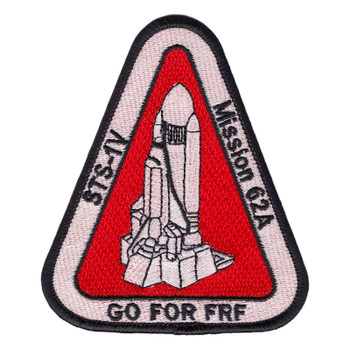
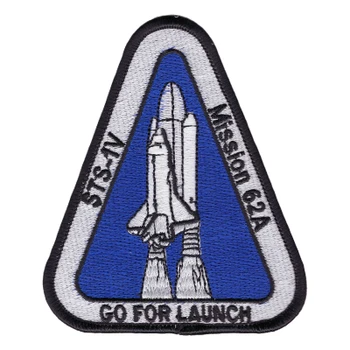
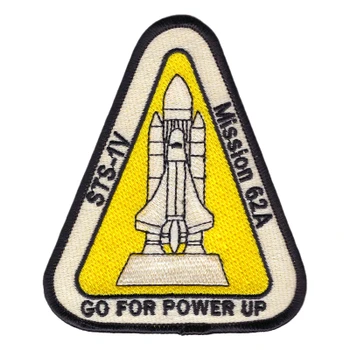
The patch is a rounded triangle about 3.5 inches wide and 4 inches tall, with a black merrowed border around a wide white band. STS-1V runs up the left side, Mission 62A down the right and GO FOR STACK across the bottom in heavy black letters. Inside, on a field of green, two white solid rocket boosters stand on the launch mount with their segment joints drawn in black. Green is the go color, and the boosters are the first hardware stacked on the pad. It is a sew-on patch, ready to be stitched to a jacket, vest or flight bag.
The loss of Challenger on 28 January 1986 grounded the shuttle fleet, and STS-62A never flew. On 31 July 1986 the Vandenberg shuttle program was put in caretaker status, and on 26 December 1989 the Air Force formally ended it, after roughly $4 billion had gone into the site. Guy Gardner, Ross and Mullane later flew together on STS-27. The pad itself went on to launch Athena rockets and then Delta IVs, the last a Delta IV Heavy for NROL-91 in September 2022. The people who readied Slick Six for the shuttle built something that kept working for decades after.
It fits a shadow box next to its companion Go For Mate patch and a photo of Enterprise on the pad at SLC-6. It is also a good gift for someone who worked the Vandenberg shuttle program in the 1980s and still calls the pad Slick Six. STS-62A never flew, but the West Coast was ready for it.
Related Products