
STS-107 Columbia Space Shuttle Mission Patch
- SKU:
- 8726
- MPN:
- 8726
- Width:
- 3.50 (in)
- Height:
- 4.75 (in)
- Depth:
- 0.08 (in)
- Backing:
- Sew On
- Edging:
- Cut Edge



Description
STS-107 has the only Shuttle mission patch shaped entirely like the orbiter, and two of the crew, Laurel Clark and Kalpana Chawla, started its design. Columbia launched from Pad 39A at Kennedy Space Center on 16 January 2003 on her 28th flight. It was a dedicated science mission, close to 16 days of microgravity and Earth science research, with no space station on the itinerary. On 1 February 2003, Columbia broke apart during reentry over Texas, and all seven crew members were lost. This patch carries each of their names.
Commander Rick Husband and pilot William McCool flew with payload commander Michael Anderson, mission specialists David Brown, Kalpana Chawla and Laurel Clark, and payload specialist Ilan Ramon, the first astronaut from Israel. Columbia carried the SPACEHAB Research Double Module on its first flight, along with the Freestar experiment carrier and the Extended Duration Orbiter pallet that let her stay up longer than a standard flight. NASA described STS-107 as a multi-discipline microgravity and Earth science research mission with a long list of international experiments. The crew worked in two shifts so research could run around the clock. The mission lasted 15 days, 22 hours and 20 minutes.
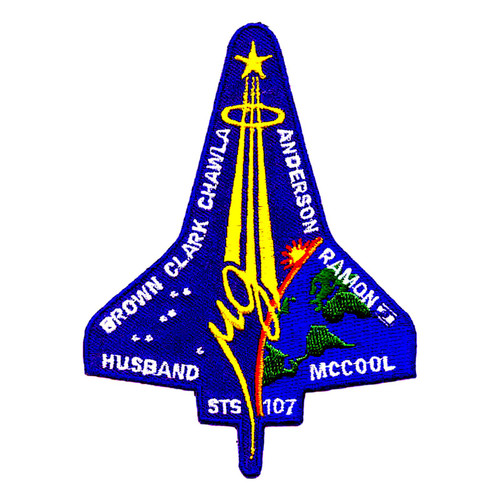
The patch follows the orbiter's outline in deep blue, about 3.5 inches wide and 4.75 inches tall, with a cut edge that traces the wings and tail. A gold astronaut symbol runs from a star at the nose down through the body, and the script microgravity symbol flows into its rays. In the mission's design, the astronaut symbol sits at 39 degrees to the Earth's horizon for the flight's orbital inclination, and the sunrise on the right stands for the dawn of new microgravity research. The small white stars at the left are Columba, the dove, chosen for peace on Earth and for Columbia, and the seven stars are the crew, also honoring the astronauts who came before. The seven names are stitched in white around the outline, with a small Israeli flag beside Ramon. It has a sew-on backing.
Columbia was the first Shuttle to reach orbit, on STS-1 in April 1981, and STS-107 was her last flight. The seven who flew her in 2003 were Navy and Air Force officers, a civilian aerospace engineer born in India, and an Israeli Air Force pilot. A year later, NASA named the Columbia Hills on Mars for the crew, with a peak for each crew member, and the Spirit rover later explored them. Their mission patch is still the first thing many people picture when they think of that crew. It is worn and displayed with respect.
It belongs in a shadow box with a photograph of the crew, or beside other Shuttle mission patches in a collection that covers the whole program. Many families also keep it for a child learning about Kalpana Chawla, Ilan Ramon and the rest of the STS-107 crew. Seven names, one orbiter, and the work they went up to do.
Related Products


