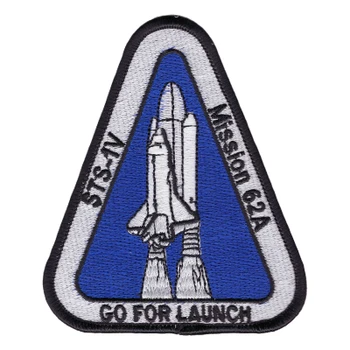
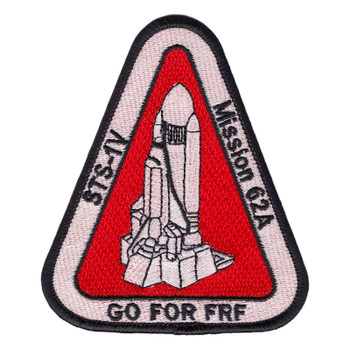
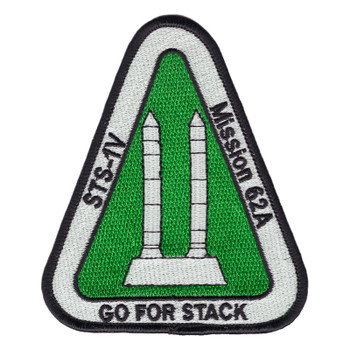
STS-62-A STS-1V Vandenberg Space Shuttle Go For Power Up Patch
- SKU:
- 10476
- MPN:
- 10476
- Width:
- 3.50 (in)
- Height:
- 4.00 (in)
- Depth:
- 0.08 (in)
- Backing:
- Sew On
- Edging:
- Merrowed Edge


Description
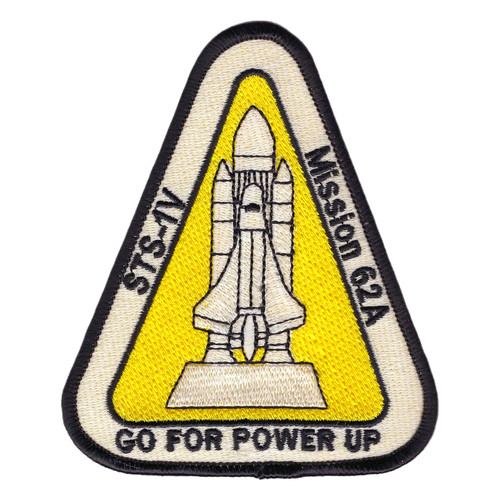
Mission 62A was planned as the first Space Shuttle launch from the West Coast, with Discovery climbing off Space Launch Complex 6 at Vandenberg Air Force Base into a near-polar orbit. It never left the ground. The loss of Challenger and her crew in January 1986 grounded the Shuttle fleet, and the flight was cancelled. Vandenberg's Shuttle pad, known to everyone who worked it as Slick Six, never hosted a Shuttle launch. This patch carries the mission number, the STS-1V lettering and three words stitched across the bottom: GO FOR POWER UP.
The designation explains itself to anyone who worked the program: the 6 stood for fiscal year 1986, the 2 for Vandenberg (a 1 meant Kennedy Space Center), and the A for the first flight from that site that year. Commander Robert Crippen led a crew of pilot Guy Gardner, mission specialists Mike Mullane, Jerry Ross and Dale Gardner, and payload specialists Brett Watterson and Edward "Pete" Aldridge. The publicly described payload was the Air Force's Teal Ruby experiment, an infrared mosaic sensor meant to help detect enemy aircraft from space. A polar launch out of Florida would have needed a dogleg ascent that cut payload capacity by about 30 percent, which is why the Shuttle needed a California pad. Enterprise was stacked at SLC-6 with an external tank and boosters for fit checks from November 1984 to May 1985, and the complex was declared operational on 15 October 1985.
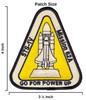
The patch is a rounded triangle about 3.5 inches wide and 4 inches tall, finished with a black merrowed border. A cream outer band frames a bright yellow triangle, and inside it stands the complete Shuttle stack: orbiter, external tank and twin solid rocket boosters, outlined in black thread on a launch platform. STS-1V runs up the left side and Mission 62A down the right, both in heavy black lettering. GO FOR POWER UP sits along the base where a team name would usually go. It has a sew-on backing, made to be stitched down to a jacket or a display board.
Slick Six took years of work by Air Force, NASA and contractor crews who rebuilt a 1960s launch site for the Shuttle. After Challenger, the Shuttle effort at Vandenberg went into caretaker status in 1986, and SLC-6 was placed in mothball status in September 1989. The polar Shuttle flights it was built for never came. The people who staffed the pad, trained for the countdown and stood up the West Coast launch team still remember Mission 62A by number. In 2023 SpaceX took over the same pad, and the West Coast story continues there.
It fits a shadow box beside other Shuttle mission patches, or the sleeve of a jacket worn by someone who spent the 1980s at Vandenberg. For a Shuttle collector, a West Coast mission that never launched fills a gap most collections leave open. It is the Shuttle flight California was built for.
Related Products