STS-62A Go For FRF Vandenberg Space Shuttle Patch

- SKU:
- 10474
- MPN:
- 10474
- Width:
- 3.50 (in)
- Height:
- 4.00 (in)
- Depth:
- 0.08 (in)
- Backing:
- Sew On
- Edging:
- Merrowed Edge


Description
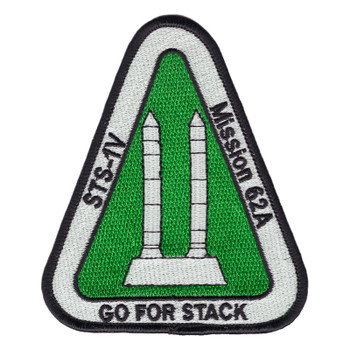
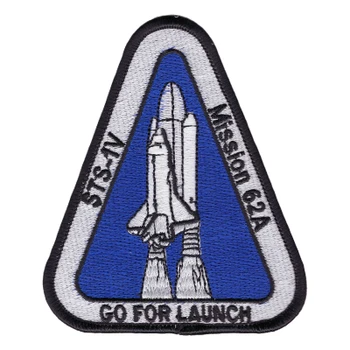
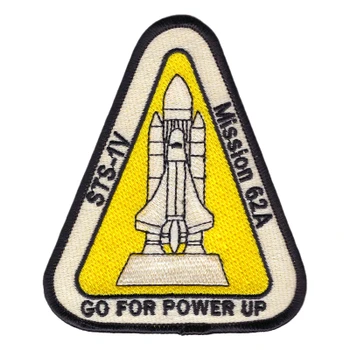
A Flight Readiness Firing lit a shuttle's three main engines on the pad for about 20 seconds, and Mission 62A was due for one at Vandenberg weeks before Discovery was to make the first shuttle launch from the West Coast. The FRF was a full test of the vehicle short of leaving the ground. Discovery had already run one at Pad 39A in Florida in June 1984. Mission 62A was set for July 1986 from Space Launch Complex 6, the pad everyone called Slick 6. GO FOR FRF across the bottom of this patch is the go-ahead for that test, and STS-1V and Mission 62A run up its sides.
NASA and the Pentagon announced the crew in February 1985. Bob Crippen, who had piloted STS-1, was to command, with Guy Gardner as pilot and Mike Mullane, Jerry Ross and Dale Gardner as mission specialists. Pete Aldridge and Brett Watterson filled out the crew as payload specialists. The main payload was Teal Ruby, an experimental staring infrared sensor for future early-warning satellites, along with an infrared telescope called CIRRIS. From Vandenberg, Discovery would have gone into a 72 degree orbit that passed over nearly every inhabited part of the Earth.
The patch is a 3.5 by 4 inch rounded triangle with a black merrowed border and a white band around a red field. In the center the full stack stands on its mount, orbiter, external tank and both solid rocket boosters stitched in white with black outline. STS-1V climbs the left side in black and Mission 62A runs down the right. GO FOR FRF sits in heavy black capitals along the base. It has a sew-on backing, so it is meant to be stitched in place rather than ironed.
Slick 6 had a long road to that point. It was started in the 1960s for the Manned Orbiting Laboratory, sat idle after that program was cancelled in 1969, and was picked for the shuttle in 1979, and in 1985 the prototype Enterprise was stacked on it for fit checks. After Challenger was lost on January 28, 1986, all West Coast shuttle missions were cancelled and the FRF never happened. The pad went on to fly the Delta IV starting in 2006, reusing the mobile service tower and the booster flame trenches built for the shuttle. For the crews, engineers and Air Force teams at Vandenberg in 1985 and 1986, this patch is the mission they got ready for.
It fits a shadow box next to a Vandenberg launch patch or a photo of the shuttle stack at SLC-6, or a jacket worn to a reunion of the West Coast shuttle team. It is a good gift for anyone who remembers when the shuttle was coming to California. This is Mission 62A, ready for its engine test.
Related Products