X-37B Target: Vandenberg Trust in the Robot Pilot Patch
- SKU:
- 10447
- MPN:
- 10447
- Width:
- 4.00 (in)
- Height:
- 4.00 (in)
- Depth:
- 4.00 (in)
- Backing:
- Iron On
- Edging:
- Merrowed Edge


Description
On December 3, 2010, the X-37B came home from more than 220 days in orbit and landed at Vandenberg with nobody aboard and nobody at the controls. It was the first autonomous reentry and landing in the history of the American space program. The Air Force called it Orbital Test Vehicle 1, OTV-1, its first unmanned reentry spacecraft. The landing came at 1:16 in the morning, and the 30th Space Wing at Vandenberg watched the deorbit and touchdown. TRUST IN THE ROBOT PILOT is the joke stitched on this patch, and that night it was also the plan.
OTV-1 launched on April 22, 2010, on an Atlas V 501 from Space Launch Complex 41 at Cape Canaveral. The design began under NASA, moved to DARPA in 2004, and became an Air Force program in 2006, run by the Air Force Rapid Capabilities Office. The X-37B is about 8.9 meters long with a 4.5 meter wingspan, small enough to ride inside a payload fairing. Gallium arsenide solar arrays recharged its lithium-ion batteries in orbit. Edwards Air Force Base stood by as the backup runway, but the vehicle came down at Vandenberg as planned. Later X-37B missions came home to Vandenberg too.
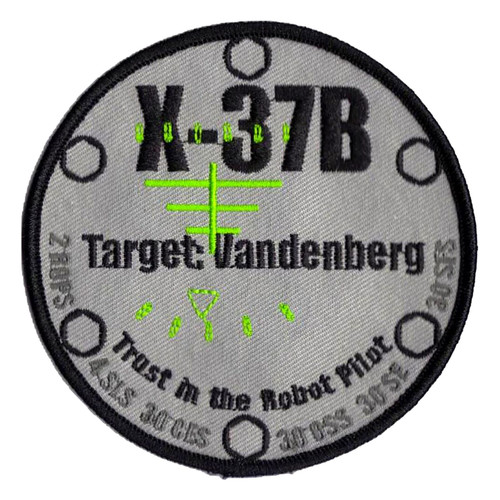
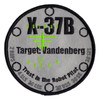
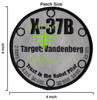
This is a round patch on light grey twill with a black merrowed border. X-37B is set in big black block letters across the top, over lime green lines that look like a landing sight. TARGET: VANDENBERG sits in the center, with small lime green marks below it, and TRUST IN THE ROBOT PILOT runs along an arc in black script. Six black hexagon outlines are spaced around the edge. Between them, grey lettering names the Vandenberg units behind a landing: 2 ROPS, 4 SLS, 30 CES, 30 OSS, 30 SE and 30 SFS. It has an iron-on backing, and a few stitches around the edge will keep it in place for good.
No pilot means the people on the ground carry the whole landing. The 2nd Range Operations Squadron runs the range. The 30th Civil Engineer Squadron keeps the runway ready, the 30th Operations Support Squadron runs the airfield, 30th Space Wing Safety watches the hazards, and the 30th Security Forces Squadron holds the perimeter. Their names are around the rim because the robot pilot only lands on a runway someone else got ready. This patch gives them the credit.
It fits a shadow box beside X-37B and Atlas V launch patches, or the jacket of someone who worked the Vandenberg range. It also makes a good gift for anyone from the 30th Space Wing who was up at 1 a.m. that December. Pin it to a board with a photo of the X-37B on the runway and the story tells itself. No crew, one runway and a lot of trust.
Related Products