NASA TDRSS Guam Tracking and Data Relay Satellite System Patch
- SKU:
- 8765
- MPN:
- 8765
- Width:
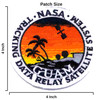
- 4.00 (in)
- Height:
- 4.00 (in)
- Depth:
- 0.08 (in)
- Backing:
- Sew On
- Edging:
- Merrowed Edge


Description
NASA's ground station on Guam traces back to a tape recorder that failed aboard the Compton Gamma Ray Observatory in March 1992. With the recorder down, the observatory needed live contact around the clock, and the relay satellites it talked through could not always reach the antennas at White Sands, New Mexico. NASA set up a limited terminal in Canberra, Australia, in late 1993. Goddard Space Flight Center then decided the Pacific needed a permanent station, and the Guam terminal was announced open in July 1998. This embroidered patch commemorates that station and the Tracking and Data Relay Satellite System it serves.
The Tracking and Data Relay Satellite System, TDRSS, came online in 1983 when Space Shuttle Challenger carried the first relay satellite, TDRS-A, to orbit. It replaced much of the old network of ground stations that tracked crewed flights, which meant longer contact with spacecraft and faster data. The White Sands Complex near Las Cruces runs the ground side, and the Guam Remote Ground Terminal is its far western extension, housing Space-Ground Link Terminal 6 and controlled remotely from New Mexico. Guam covers the Zone of Exclusion, the patch of sky over the Indian Ocean that White Sands cannot see through the satellites, a job an auxiliary system on Diego Garcia handled before Guam came online. The Space Shuttle, the International Space Station, the Hubble Space Telescope and Landsat have all sent their data through the system.
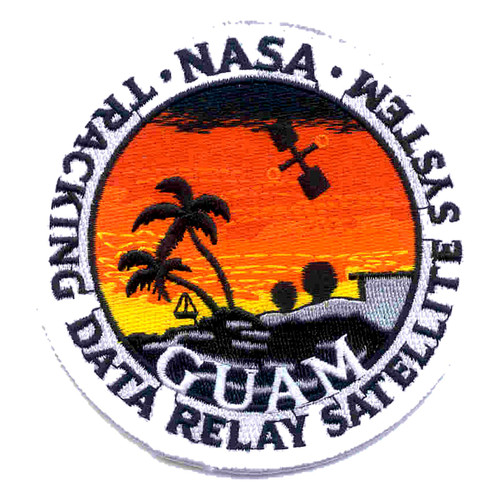
The patch is a 4 inch circle with a white merrowed border and a white ring carrying NASA at the top and TRACKING DATA RELAY SATELLITE SYSTEM around the rest in black block letters. Inside is an island sunset stitched in orange, red and yellow. Two black palm trees lean in from the left with a small white sailboat on the water below them. A relay satellite hangs in the sky with its dish antennas spread, and on the shore sit two round domes and a low building, the radomes that keep Guam's frequent rain off the antennas. GUAM runs across the water in big white letters. It has a sew-on backing.
Guam is the station that finished the map. Before it opened, NASA described the terminal as completing the agency's worldwide communications coverage, with full-time, real-time support for the Shuttle, the space station and Hubble. Part of its cost was covered by shutting down the Canberra station that had filled in since 1993. The antennas sit under domes because the island's weather would interfere with them otherwise, which says a lot about what keeping that link open takes. Every pass a spacecraft makes through the Indian Ocean gap runs through this small station on the far side of the Pacific.
It belongs in a shadow box with Shuttle mission patches or on the jacket of someone who worked the Space Network, at Goddard, White Sands or on the island. It also makes a good gift for anyone who has been stationed on Guam and wants something other than a beach. It is the patch for the station most people never knew was there.
Related Products