NASA On The Cutting Edge Satellite Communications Patch
- SKU:
- 8761
- MPN:
- 8761
- Width:
- 4.00 (in)
- Height:
- 4.00 (in)
- Depth:
- 0.08 (in)
- Backing:
- Sew On
- Edging:
- Merrowed Edge


Description
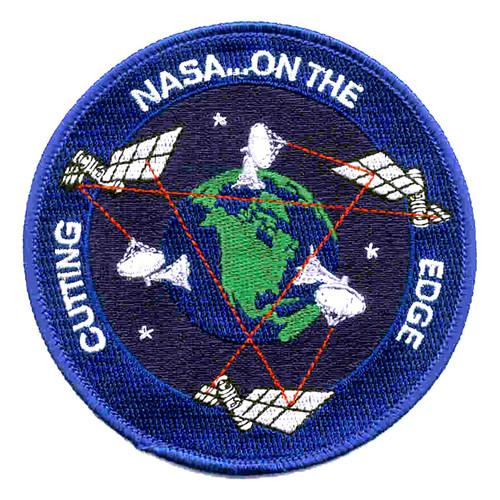
NASA's first communications satellite was a balloon: Echo 1 reached orbit on August 12, 1960, and bounced radio signals from one ground station to another without amplifying them. It was about 100 feet across when inflated. Every relay satellite since has done the same basic job with far more power. This patch draws that job out in thread, satellites and dish antennas linked by red signal lines over North America. NASA...ON THE CUTTING EDGE runs around the border.
Three years after Echo, NASA launched Syncom 2 from Cape Canaveral on July 26, 1963, the world's first geosynchronous communications satellite, built by Hughes Aircraft. That August it carried a live call between President Kennedy and Nigerian Prime Minister Balewa. Syncom 3 followed on August 19, 1964, and relayed television of the Tokyo Olympics to the United States. In April 1983 Challenger's first flight, STS-6, deployed the first Tracking and Data Relay Satellite, which had to use its own thrusters to reach its proper orbit after its upper stage fell short. TDRS satellites work about 22,236 miles up and route their traffic through ground terminals at NASA's White Sands Complex near Las Cruces, New Mexico, and on Guam.
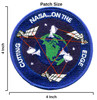
The patch is a 4 inch circle with a royal blue merrowed border and a broad blue band carrying the motto in white block capitals. Inside, a green and blue globe sits on a navy field with a few white stars. Three satellites with gridded solar wings circle it, and three white dish antennas point up from around it. Red dashed lines run between them and cross over the globe, the paths a signal takes from dish to satellite and back down. It has a sew-on backing, meant to be stitched to a jacket, vest or bag.
The relay network replaced a worldwide chain of ground stations that could only talk to a spacecraft while it passed overhead. Thirteen TDRS satellites have been launched, and one was lost with Challenger on STS-51-L in January 1986. The rest have carried voice and data for the International Space Station and other spacecraft. The people who build and run those links rarely make the news, and the system works because they keep it working.
It fits a shadow box with a White Sands or Goddard patch, or the jacket of someone who spent a career on antennas and link budgets. It is also a good gift for a young engineer heading into the space communications field. One round patch, three satellites, one connected sky.
Related Products