
TDRS-G Flight 7 STS-70 Discovery Tracking and Data Relay Satellite Patch
- SKU:
- 10515
- MPN:
- 10515
- Width:
- 5.00 (in)
- Height:
- 3.00 (in)
- Depth:
- 0.08 (in)
- Backing:
- Iron On
- Edging:
- Merrowed Edge


Description
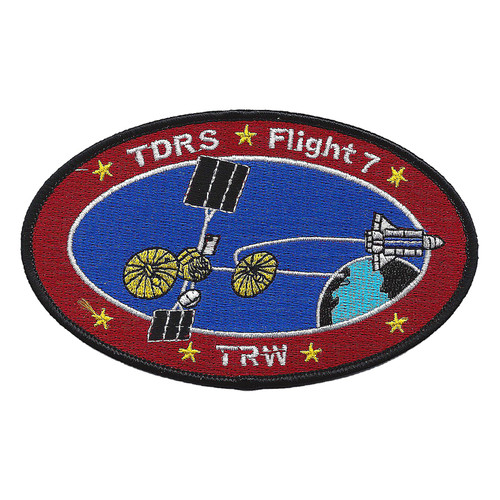
The seventh Tracking and Data Relay Satellite went up about five weeks late because northern flicker woodpeckers had pecked holes in Discovery's external tank foam on the pad. NASA rolled the stack back to the Vehicle Assembly Building for repairs and moved STS-71 ahead of it. Discovery finally launched from Pad 39B on July 13, 1995, with TDRS-G in the payload bay. About six hours later the crew deployed the satellite, and its Inertial Upper Stage fired to start the climb to geosynchronous orbit. This patch is TDRS Flight 7, the satellite and the shuttle that carried it.
Terence Henricks commanded STS-70, with Kevin Kregel as pilot and Nancy Currie, Donald Thomas and Mary Ellen Weber as mission specialists. It was Discovery's 21st flight and lasted 8 days, 22 hours and 20 minutes before landing at Kennedy Space Center on July 22. STS-70 was the first flight of the new Block I space shuttle main engine and the first shuttle mission run from the new Mission Control Center room in Houston. TRW built TDRS-G, the seventh satellite in NASA's Tracking and Data Relay Satellite System. Once checked out in orbit it joined the network as a spare. TDRS satellites relay voice, data and video between spacecraft in low orbit and the ground.
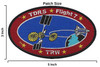
The patch is a 5 by 3 inch oval with a black merrowed border around a dark red band. TDRS and Flight 7 run across the top in white between yellow stars, with TRW centered along the bottom. Inside, on a royal blue field, the satellite spreads its two black solar arrays above and below a pair of large gold mesh dish antennas. A white orbit line runs from the satellite to a white space shuttle orbiter passing over a blue and black Earth at the right. It has an iron-on backing, and a few stitches around the border will hold it for good.
Before TDRS, a spacecraft in low orbit could only talk to the ground while it passed over a tracking station. The relay satellites in geosynchronous orbit changed that and gave the shuttle and later the Hubble Space Telescope and the International Space Station near-constant contact. Each new TDRS kept that network healthy, and Flight 7 was part of it. The engineers who built, tested and launched these satellites rarely got their names in the news. This patch remembers one of their flights.
It fits a shadow box with an STS-70 crew patch, or the sleeve of a jacket for someone who worked TDRS at White Sands or on the shuttle program. It is also a good gift for a retired engineer who spent his career building satellites. The gold dishes stand out against the blue. One satellite, one shuttle and a long climb to geosynchronous orbit.
Related Products


