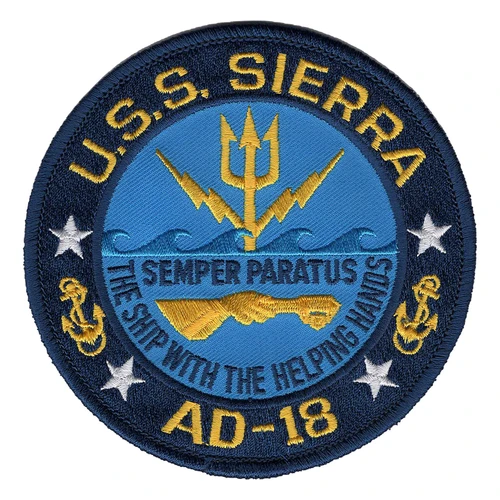
USS Sierra AD-18 Destroyer Tender Ship Patch
- SKU:
- 7816
- MPN:
- 7816
- Width:
- 4.00 (in)
- Height:
- 4.00 (in)
- Depth:
- 0.08 (in)
- Backing:
- Iron On
- Edging:
- Merrowed Edge



Description
When USS Sierra AD-18 was decommissioned on 15 October 1993, she was the oldest active-duty warship in the United States Navy. She had been commissioned on 20 March 1944, in the middle of the Pacific war, and kept working for almost half a century. Sierra was a Dixie-class destroyer tender built by Tampa Shipbuilding Company in Tampa, Florida, designed to fix destroyers in or near the battle area. Her crews called her The Ship with the Helping Hands, and the patch says so. Tin can sailors who came alongside her knew the name was earned.
Sierra went to the Pacific in 1944, serviced ships at Pearl Harbor, then supported the Third Fleet from Manus until February 1945. Her repair force worked on a 5-inch gun mount for the battleship USS California BB-44 and rebuilt the stern of the destroyer USS Claxton DD-571 after a kamikaze hit off Leyte Gulf. She went on to serve the Fifth Fleet at Ulithi and in the Philippines, and was at Shanghai after the war. From 1949 she was homeported in Norfolk, Virginia, and from 1974 in Charleston, South Carolina, with Mediterranean cruises out of Naples in the late 1970s. Her crew also earned a humanitarian award for relief work in Mobile, Alabama, after Hurricane Frederic.
The patch is a 4-inch round with a navy outer ring and U.S.S. SIERRA stitched in gold across the top, AD-18 at the bottom. White stars and gold fouled anchors flank the ring on both sides. In the light blue center a gold trident rises out of the waves between two lightning bolts, over the motto SEMPER PARATUS, always ready. Below it two gold hands clasp, and the words THE SHIP WITH THE HELPING HANDS arc around the edge, the whole job of a tender in one picture.
It measures 4 inches wide by 4 inches tall with a merrowed edge, the raised rolled border that keeps a round patch from fraying, and an iron-on backing. Sewing it on is always the strongest way to attach it. The gold thread stands out well against the navy and light blue. It sits flat on a jacket, a vest or a shadow box backing board.
Sierra was struck in 1993 and sold for scrap in 1995, so this patch is one of the few things a former crew member can still put his hands on. It fits a shadow box beside a cruise book and a set of rating badges, or the vest worn to a tender reunion. It is also a good gift for a father or grandfather who worked in her shops in Norfolk or Charleston. She was always ready, and so were the sailors who kept her that way.
Related Products