
Norfolk Naval Station Virginia Patch

- SKU:
- 86
- MPN:
- 86
- Width:
- 4.50 (in)
- Height:
- 4.50 (in)
- Depth:
- 0.08 (in)
- Backing:
- Iron On
- Edging:
- Cut Edge



Description
Naval Station Norfolk sits on the grounds of the 1907 Jamestown Exposition at Sewell's Point, a waterfront that senior naval officers had judged ideal for a naval base well before the Navy bought it. The purchase finally came in April 1917, the month the United States entered World War I: 474 acres and $1.6 million to build on. Today it is the world's largest naval station, with about four miles of waterfront and eleven miles of pier and wharf space. Seventy-five ships berth along its fourteen piers, and Chambers Field holds 134 aircraft in eleven hangars. It is headquarters and home port for Fleet Forces Command and home port to four carrier strike groups.
Crews dredged about eight million cubic yards in the fall and winter of 1917 to push the northern shoreline out, and a seaplane field opened at the Naval Operating Base that October. By Armistice Day 1918 about 34,000 enlisted men were stationed there. The airfield became NAS Hampton Roads in August 1918 and NAS Norfolk in July 1921. Recruit training ended in December 1942 as the base turned to advanced training, and after World War II Norfolk was home of the Atlantic Fleet. The Naval Operating Base became Naval Station Norfolk in January 1953, and when NAS Norfolk was disestablished on 5 February 1999, Chambers Field became part of the station, which is home port to carriers such as USS Dwight D. Eisenhower CVN-69.
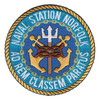
The patch is a 4.5 inch round with a cut edge and a gold twisted rope border. "NAVAL STATION NORFOLK" arcs across the top in white on a turquoise ring, and "AD REM CLASSEM PARATUS" runs along the bottom. Inside, a gold chain circles a blue center. A white trident stands upright on a brown shaft between two crossed gold anchors, with a brown line wound in loose turns around the shaft and both anchor shanks. The Latin is built on the words for fleet (classem) and ready (paratus), which suits a station whose whole job is getting ships ready for sea.
For a huge share of the Atlantic Fleet, Norfolk is the pier they left from and the pier they came home to. Carriers, cruisers, destroyers and amphibious ships have all tied up along that waterfront, and the families waiting on the pier at homecoming are part of the place as much as the cranes. The station also hosts Marine Corps, Army, Air Force and Coast Guard personnel alongside the Navy. It celebrated its centennial on 26 January 2017. Anyone who stood duty there or made a homecoming at those piers will know the trident and anchors on sight.
It fits a shadow box next to a ship's plaque or a cruise book from a Norfolk-based deployment, or a jacket worn to a ship's reunion. It is also a good gift for a sailor's son or daughter who grew up hearing about the piers. Measures 4.5 x 4.5 inches with a cut edge and iron-on backing, and it can also be sewn on. For a lot of sailors, this is the address that was home.
Related Products


