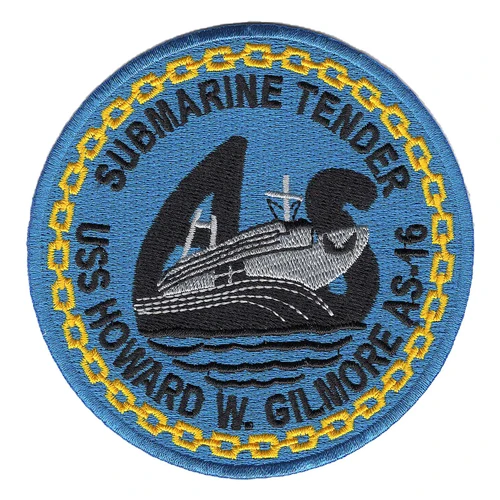
USS Howard W. Gilmore AS-16 Submarine Tender Patch
- SKU:
- 3928
- MPN:
- 3928
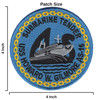
- Width:
- 4.00 (in)
- Height:
- 4.00 (in)
- Depth:
- 0.08 (in)
- Backing:
- Iron On
- Edging:
- Cut Edge


Description
This submarine tender was first named Neptune, but she went down the ways at Mare Island on 16 September 1943 carrying the name of Commander Howard W. Gilmore, sponsored by his widow. Gilmore commanded the submarine USS Growler. On the night of 6 to 7 February 1943, Growler rammed an enemy gunboat in a surface attack, and gunfire swept her bridge. Gilmore ordered his men below and gave the order to take her down. Growler dived and her crew brought her home, and Gilmore received the Medal of Honor after his death.
USS Howard W. Gilmore AS-16 was a Fulton class tender, commissioned on 24 May 1944. She reached Majuro Atoll in September 1944 and worked from Pearl Harbor, Brisbane and Subic Bay before the war ended. From 1946 she served Submarine Squadron 4 at Key West, then moved to Charleston in 1959. A FRAM overhaul at Charleston Naval Shipyard in 1961 and 1962 gave her the shops to service nuclear submarines, and in October 1962 she supported two submarine squadrons during the Cuban Missile Crisis. In the 1970s she worked out of Santo Stefano, La Maddalena, Sardinia, before her decommissioning on 30 September 1980.
The patch is round, 4 inches across, with a sky blue field inside a ring of gold anchor chain. SUBMARINE TENDER arcs across the top in black letters, and USS HOWARD W. GILMORE AS-16 curves along the bottom. In the center, two tall black letters A and S frame a gray tender angled toward the viewer, her mast and superstructure stitched in white and gray. Black wave lines run under her hull. The design keeps it simple, a tender, her hull letters and the chain that ties her to the boats.
Tender sailors kept the boats running, and the boats knew it. Machinists, torpedomen, welders and storekeepers worked alongside submarines nested at the tender's side, turning out repairs that let a boat get back to sea on schedule. The ship's motto was Service for the Silent Service, and she lived it for 36 years, from Majuro to Sardinia. Her name carried the story of a skipper who put his boat ahead of himself. A crew that served under that name knew what it meant.
The iron-on backing presses onto a cotton or denim jacket, and a few stitches around the cut edge will hold it through heavy wear. It fits a shadow box with dolphins and a photo of a nest of boats alongside, or a vest worn to a tender reunion. It also makes a good gift for a father or grandfather who spent his Navy years in the shops. Howard W. Gilmore, AS-16, service for the silent service.
Related Products