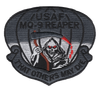
USAF MQ-9 Reaper That Others May Die Hook Backing Patch

- SKU:
- 8941
- MPN:
- 8941
- Width:
- 4.00 (in)
- Height:
- 3.50 (in)
- Depth:
- 0.08 (in)
- Backing:
- Hook Only
- Edging:
- Cut Edge




Description
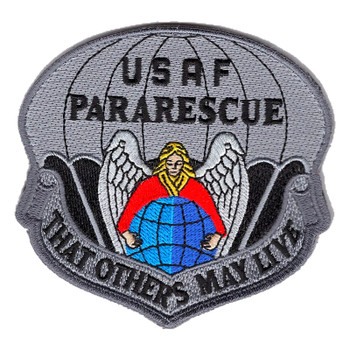
The pararescue creed closes with "These things we do, that others may live," and the Reaper community kept three of those last four words and changed the fourth. That single swap is the whole joke on this patch, and anyone who has worn a PJ beret or sat in a ground control station gets it before he finishes reading the scroll. "USAF MQ-9 REAPER" runs across the top, "THAT OTHERS MAY DIE" runs along the bottom, and between them a hooded Grim Reaper holds his scythe. Rescue crews go in to bring Americans home. Reaper crews are the ones an enemy fighter never hears until it is too late, and the patch sets those two jobs side by side without cracking a smile.
The General Atomics MQ-9 Reaper first flew on February 2, 2001, as Predator B-001, and the Air Force later gave it the name Reaper. It was built as a hunter-killer, a turboprop that can loiter over a target for hours and then strike it with AGM-114 Hellfire missiles, GBU-12 Paveway II laser-guided bombs or GBU-38 JDAMs. The 432nd Wing was activated at Creech Air Force Base, Nevada, on May 1, 2007, to fly the MQ-9 alongside the MQ-1 Predator, and the Reaper flew its first combat strike over Afghanistan that October. A crew is a pilot and a sensor operator, often joined by a mission intelligence coordinator, working the aircraft from a ground station a world away. On a long surveillance sortie the airframe can stay up for more than a day, longer than any one crew sits at the controls.
The patch is a 4 by 3.5 inch badge with a cut edge, trimmed to its outline and finished with a black stitched border. The palette is subdued on purpose: charcoal and mid-gray twill, black lettering, and a pale gray band behind the figure. The Reaper's skull and bony hand are white, his eyes burn red, and the only other color is the red running off the scythe blade and the dark red-brown of its handle. Thin black lines sweep down from the top of the badge to a scroll that curls at both ends, where the motto sits. The back carries a hook backing, hook side only, so it presses onto any loop panel on a plate carrier, flight jacket or range bag.
Dark humor has ridden along with American combat aviation since the first nose art, and the RPA community took to the habit quickly. Naming an aircraft after Death more or less guaranteed that crews would draw him on everything. Turning the PJ motto around is a nod as much as a joke, because pararescuemen are among the most respected people in the Air Force and every airman knows their line. The patch says out loud what Reaper crews already know: the job is protecting the friendly forces on the ground, and the weapon does exactly what its name says.
Put it on the loop panel of a range bag, a backpack or a flight jacket, or mount it in a shadow box next to a squadron coin and a Creech photo. It also makes a sharp gift for a sensor operator, a Reaper pilot or the PJ in the family who will appreciate the jab. It is a small piece of RPA culture that anyone who flew the mission will recognize across a room.
Related Products