
Pararescue Jumper Patch That Others May Live Hook and Loop Version

- SKU:
- 6024
- MPN:
- 6024
- Width:
- 3.75 (in)
- Height:
- 3.75 (in)
- Depth:
- 0.08 (in)
- Backing:
- Hook & Loop
- Edging:
- Cut Edge



Description
In August 1943, Lt. Col. Don Flickinger jumped into the Burma jungle with two combat surgical technicians to reach twenty men who had bailed out of a C-46, and pararescuemen count that jump as the start of their trade. The Air Rescue Service was established on May 29, 1946, and pararescue teams were authorized on July 1, 1947. The motto comes from the Code of the Air Rescueman, written by the first ARS commander, Lt. Col. Richard T. Kight. It ends with the line every PJ knows: These things we do, that others may live. The job has not changed since Burma. Someone is down, and a PJ goes to get him.
The PJ pipeline runs about two years and loses roughly eight candidates in ten. It starts with selection at Lackland, then Army Airborne School at Fort Benning, the Combat Dive Course at Panama City and Military Free Fall at Fort Bragg and Yuma. SERE comes at Fairchild, followed by EMT-Paramedic training and the Pararescue Apprentice Course at Kirtland, which ends with the maroon beret first authorized in 1966. In Vietnam, PJs rode HH-3 Jolly Green Giants, HH-43 Huskies and HH-53 Super Jolly Green Giants, with HC-130 King birds coordinating and refueling. A1C William H. Pitsenbarger's Air Force Cross from that war was later upgraded to the Medal of Honor. Twelve of the roughly 200 Air Force Cross recipients are pararescuemen.
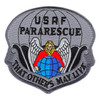
The patch measures 3.75 inches by 3.75 inches with a cut edge that follows its shield and scroll outline, finished in a dark gray stitched border. USAF PARARESCUE is stitched in black across a gray parachute canopy that fills the top half. Below it, a winged angel with gold hair and a red robe holds a blue globe in both hands. In rescue tradition the red robe stands for valor and the angel holding the globe for protection and rescue. THAT OTHERS MAY LIVE curves along the gray scroll at the bottom. It has a hook and loop backing, so it moves between a flight suit, a plate carrier and a bag.
Bill Steffens designed the Air Rescue Service emblem of the angel holding the world, adopted in 1952, and pararescuemen have kept her close ever since. Ten of the Air Force Crosses awarded in Vietnam went to pararescue forces. Those numbers come from a career field that graduates only a small group each year. The men who wear the beret are trained as paramedics, combat divers and free fall parachutists, and they use all of it on the worst day of someone else's life. Pilots who were pulled out of the jungle or the water still remember the name of the PJ who came down the hoist.
It belongs on the kit bag of a PJ or Combat Rescue Officer, or in a shadow box with a maroon beret flash and a set of jump wings. It also makes a good gift for a father who flew rescue or a son who just started the pipeline. Gray thread, a red robe and the four-word motto.
1 Review
-
Overall great patch
Just missed line on bottom scroll. But patch looks great overall
Related Products


