US Naval Hospital Guantanamo Bay Patch

- SKU:
- 12324
- MPN:
- 12324
- Width:
- 4.50 (in)
- Height:
- 4.50 (in)
- Depth:
- 0.08 (in)
- Backing:
- Iron On
- Edging:
- Cut Edge


Description
When the hospital on Caravella Point was dedicated on September 24, 1956, it was the first fully air-conditioned Naval Hospital, built for $2.5 million. U.S. Naval Hospital Guantanamo Bay had been established ten years earlier, on June 1, 1946, replacing the Naval Dispensary with 150 beds. Capt. Paul M. Crossland was its first Medical Officer in Command. Navy medicine at Guantanamo goes back to 1898, when a dispensary on North Toro Cay was simply called the hospital. Today about 250 people staff it, caring for a base population of roughly 6,000.
Corpsmen at Naval Station Guantanamo Bay learned early to plan for weather. During Hurricane Hazel in October 1954, 82 patients and staff rode out the storm in the underground hospital, a 200-bed facility dug in south of Radio Point in early 1943, and it opened again three times as a shelter during Hurricane Flora in 1963. In October 1962 the hospital evacuated patients and dependents during the Cuban Missile Crisis. From August 1994 to February 1996, Operation Sea Signal brought Navy and Marine medical people to more than 50,000 Haitian and Cuban migrants. The hospital earned the Navy Unit Commendation for running a Humanitarian Relief Center for more than 16,300 migrants in 1991 and 1992, and a Meritorious Unit Commendation for its care and logistics during Operation Enduring Freedom from December 2001 to January 2003.
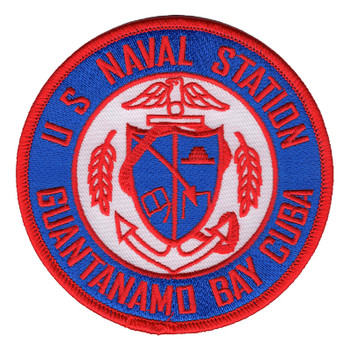
The patch is a round disc framed in a heavy gold rope border, the kind of line work every sailor knows from the deck. U.S. NAVAL HOSPITAL arcs across the top of a navy band and GUANTANAMO BAY runs along the bottom, both in gold, with two gold oak-leaf sprigs set on each side. In the white center a big red cross carries a blue outline of Cuba trimmed in gold. A small white caduceus, the hospital corpsman's device, sits right at the southeastern tip of the island, which is exactly where the bay is. It measures 4.5 inches across with a cut edge and an iron-on backing.
A tour at Guantanamo was a small-town tour with a hospital at its center. Base children were born there, including the first set of triplets delivered in August 1956, and the staff ran mass inoculations, flu wards and air evacuation flights to the mainland and San Juan. The 1957 influenza epidemic pushed the census to a record 135 patients on October 27. Corpsmen, nurses and doctors who served there handled everything from routine sick call to migrant camps and detainee operations, often with the nearest stateside hospital a flight away. That self-reliance is what people who worked at Naval Hospital Guantanamo Bay remember.
Frame it in a shadow box with your Hospital Corps or Navy Nurse Corps patches, or iron it onto the jacket you wear to the next corpsman reunion. It is a gift a former Gitmo corpsman or nurse will know at a glance. A small hospital at the end of a long supply line, and the people who kept it running.
Related Products