
UH-60 Black Hawk US Army Utility Helicopter Patch
- SKU:
- 100309
- Width:
- 4.00 (in)
- Height:
- 4.00 (in)
- Depth:
- 0.02 (in)
- Backing:
- Iron On
- Edging:
- Merrowed Edge


Description
The Black Hawk carries the name of a Sauk leader, and the first ones went to the 101st Airborne Division's aviation brigade in June 1979. Sikorsky built it for the Army's Utility Tactical Transport Aircraft System competition, flew the YUH-60A prototype on October 17, 1974, and won a fly-off against the Boeing Vertol YUH-61. The Army picked the UH-60 for production in December 1976. It was bought to replace the UH-1 Iroquois, the Huey, as the Army's tactical transport helicopter. The UH-60A carried a crew of four and up to 11 equipped troops on two General Electric T700 turboshafts.
The UH-60 saw combat for the first time in Grenada in 1983 and flew again in the invasion of Panama in 1989. In the Gulf War, Black Hawks were part of the largest air assault mission in Army history, with more than 300 helicopters involved. On February 27, 1991, two UH-60s were shot down while flying combat search and rescue, and in Mogadishu in 1993 two more Black Hawks went down in the battle that followed. The family grew with every mission: the UH-60L with T700-GE-701C engines, the UH-60M with the 701D, the HH-60L and HH-60M medevac versions, and the MH-60 special operations variants flown by the 160th Special Operations Aviation Regiment, the Night Stalkers.
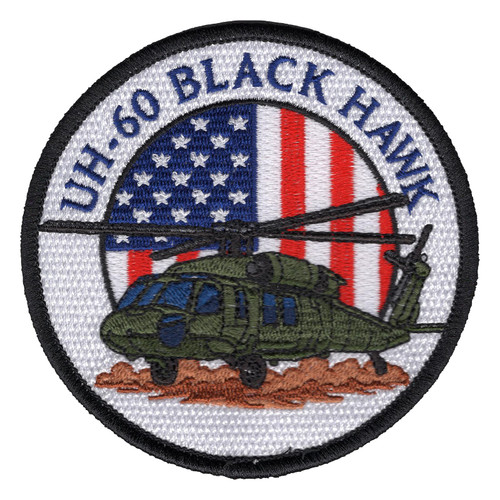
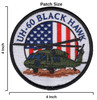
The patch is a 4 by 4 inch round with a black merrowed edge. A green UH-60 sits on a cloud of tan dust, main rotor stretched nearly edge to edge, with blue-tinted cockpit glass and the long tail boom running back to the tail rotor. Behind it the Stars and Stripes fill a circle, the blue field of white stars on the left and red and white stripes on the right. UH-60 BLACK HAWK arches over the top in navy blue letters on a white ring. The backing is iron-on, and it sews on just as well if you want it permanent.
For more than four decades Black Hawk crews have flown troops into landing zones, hauled sling loads and carried wounded soldiers out on medevac missions. Pilots remember their first hover in one. Crew chiefs know the cabin, the gunner's windows and every latch on the cowlings, and the repairers who kept the T700s and the transmission deck healthy know the rest. The aircraft has gone everywhere the Army has gone since 1983, and the losses in the Gulf and in Mogadishu are part of its record. Anyone who flew in one, crewed one or fixed one is part of that same history.
It fits a shadow box with your aviation wings and your battalion patch, or the jacket you wear to a crew reunion. It also makes a good gift for a son or daughter who crewed Hawks, or for a grandkid who wants to know what you flew. A green Hawk, the flag behind it, and dust under the wheels.
Related Products


