STS-98 ISS-5A Destiny U.S. Lab Space Station Patch
- SKU:
- 9149
- MPN:
- 9149
- Width:
- 5.00 (in)
- Height:
- 3.00 (in)
- Depth:
- 0.08 (in)
- Backing:
- Sew On
- Edging:
- Merrowed Edge


Description
On February 10, 2001, Marsha Ivins used the robotic arm of Space Shuttle Atlantis to lift the Destiny laboratory out of the payload bay, turn it 180 degrees and attach it to the forward port of the Unity node. That move gave the International Space Station its U.S. laboratory. Destiny is a 28-foot module that weighed about 32,000 pounds at launch, and it raised the station's living and working volume by 41 percent. It was the first NASA laboratory in permanent use since Skylab, nearly three decades earlier. Waiting aboard to receive it was the Expedition One crew of William Shepherd, Yuri Gidzenko and Sergei Krikalev, who had been on the station for more than three months.
Atlantis launched from Pad 39A at Kennedy Space Center shortly after sunset on February 7, 2001, the first human spaceflight launch of the 21st century. Kenneth Cockrell commanded, with Mark Polansky as pilot and Robert Curbeam, Marsha Ivins and Thomas Jones as mission specialists. Less than two days later Cockrell docked Atlantis to Pressurized Mating Adapter 3 on Unity. Jones and Curbeam made three spacewalks on February 10, 12 and 14, connecting Destiny's power and data lines, helping move PMA-2 to the lab's forward end, and installing a spare communications antenna. The mission included the 100th spacewalk in U.S. spaceflight history. Bad weather at Kennedy kept the crew in orbit two extra days, and Atlantis landed at Edwards Air Force Base, California, on February 20 after nearly 13 days.
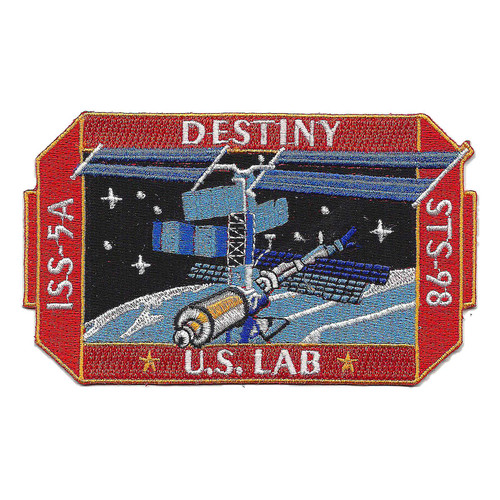
The patch is about 5 by 3 inches, a wide red frame with clipped corners, a stepped tab on each side and a rolled gold merrowed border. DESTINY runs across the top in white, and U.S. LAB sits along the bottom between two small gold stars. ISS-5A runs up the left side and STS-98 down the right, the station assembly flight and the shuttle mission that carried it. In the black center the station spreads its long blue solar arrays over a lattice truss, with a white and gold module out front, an orbiter docked at lower right and the curve of the Earth below. It has a sew-on backing.
Destiny was built by Boeing at the Michoud Assembly Facility and Marshall Space Flight Center. It was designed to hold 10 systems racks and 13 research racks, but it went up with only five systems racks because of shuttle weight limits, and the rest followed on later flights. Those first racks ran the station's power distribution, cooling, air revitalization, and temperature and humidity control. The lab also has a window that looks straight down at the Earth. For the people who built, flew and supported STS-98, Destiny was the point where the station started to become a working research facility.
It fits a shadow box next to an STS-97 or Expedition One patch, or a jacket worn to a Space Coast launch. It is also a good gift for someone who worked the early station assembly flights at Kennedy, Johnson or Marshall. Destiny is still the American laboratory on the station, and STS-98 is the flight that put it there.
Related Products