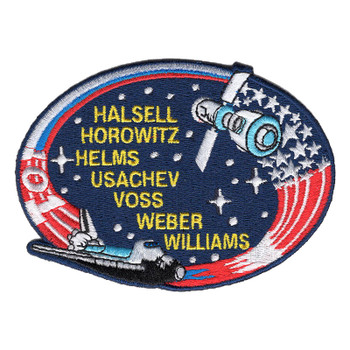
STS-101 Atlantis ISS Space Shuttle Mission Patch
- SKU:
- 9498
- MPN:
- 9498
- Width:
- 4.75 (in)
- Height:
- 3.50 (in)
- Depth:
- 0.08 (in)
- Backing:
- Iron On
- Edging:
- Merrowed Edge


Description
STS-101 was the first Space Shuttle mission to fly with a glass cockpit, and Atlantis used it to fly a station repair job in May 2000. The crew of seven docked to the International Space Station when it was still only two modules, the U.S.-built Unity node and the Russian-built Zarya. Their job was to fix what had worn out and stock the station for the crews to come. Three April launch attempts were scrubbed for high winds and overseas landing site weather before Atlantis finally launched from Launch Complex 39A on May 19, 2000. Ten days later the crew brought her home to the Kennedy Space Center runway.
Commander James Halsell and Pilot Scott Horowitz flew Atlantis to a docking at Unity's forward port on May 21. Mission specialists Mary Ellen Weber, Jeffrey Williams, James Voss, Susan Helms and cosmonaut Yuri Usachev made up the rest of the crew. Voss and Williams spent 6 hours and 44 minutes outside, securing a U.S.-built crane, installing parts of a Russian Strela crane, replacing a faulty antenna and adding handrails, with Weber moving Voss on the robotic arm. Inside, the crew installed four new batteries in Zarya along with smoke detectors, cooling fans and a new power distribution box, and delivered more than 3,300 pounds of gear from a Spacehab double module. Before leaving, Atlantis fired its jets to raise the station's orbit by about 27 miles.
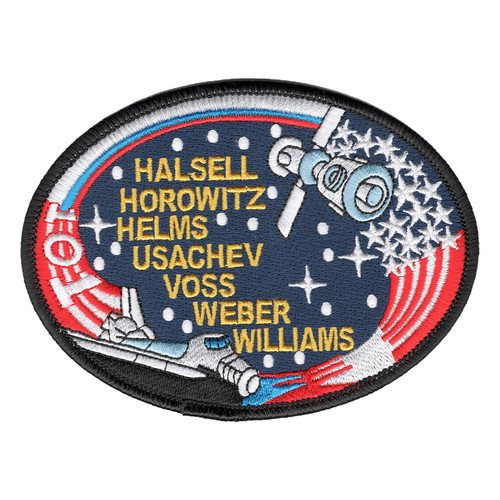
The patch is a 4.75 by 3.5 inch oval with a black merrowed border and a navy field scattered with stars. All seven crew names are stitched in gold down the middle, HALSELL through WILLIAMS. The station rides in the upper right as it looked at the time, Unity and Zarya with their solar arrays, and the orbiter sweeps across the bottom with its payload bay open. Three large four-point stars stand for STS-101 as the third shuttle flight of the station assembly sequence. The border bands carry the colors of the American and Russian flags, the two nations of the crew, with 101 in white on red along the left side. It has an iron-on backing, and a few stitches around the edge will hold it for good.
STS-101 is one of the shuttle flights that made the station livable before anyone moved in for good. It came before Zvezda arrived that summer and before the Expedition 1 crew took up residence later in 2000, and the batteries, fans and supplies Atlantis left behind were part of that groundwork. Helms and Voss would go back to the station the next year as members of the Expedition 2 crew, and Usachev commanded it. Every long-duration crew since has lived aboard a station built on flights like this one.
It fits a shadow box next to other Atlantis and station assembly patches, or the sleeve of a jacket worn to a Kennedy Space Center visit. It is also a good gift for someone who followed the early ISS flights or worked the shuttle program. Seven names, one orbiter and the start of a station, all on one oval.
Related Products