STS-120 ISS Flight 10A Harmony Node 2 Space Shuttle Patch
- SKU:
- 9185
- MPN:
- 9185
- Width:
- 4.50 (in)
- Height:
- 3.75 (in)
- Depth:
- 0.08 (in)
- Backing:
- Iron On
- Edging:
- Merrowed Edge


Description
When Discovery docked to the International Space Station on STS-120 in October 2007, both spacecraft were under the command of women for the first time: Pamela Melroy on the shuttle and Peggy Whitson on the station. The flight was ISS assembly flight 10A, and its cargo was Node 2, the module that a NASA naming contest for US schoolchildren named Harmony in March 2007. Harmony was the first pressurized living space added to the station since 2001, and it grew the station's living volume by about 20 percent. It became the hub that would connect the US Destiny laboratory with Europe's Columbus and Japan's Kibo. It also gave visiting vehicles, the shuttle and Japan's cargo ship among them, a place to dock or berth.
Discovery launched from Launch Complex 39A at Kennedy Space Center on October 23, 2007, and landed back at Kennedy on November 7 after about 15 days. Melroy commanded, with George Zamka as pilot and mission specialists Douglas Wheelock, Stephanie Wilson, Scott Parazynski and Paolo Nespoli, an Italian astronaut with the European Space Agency, while Daniel Tani rode up to join the station crew and Clayton Anderson came home. Harmony went first onto the Unity node and was later moved by the station's robotic arm to the forward port of Destiny. The crew also moved the P6 truss and its solar arrays from the top of the Z1 truss out to the port end of the main truss. When one of those arrays tore during deployment, Parazynski, with Wheelock's help, installed five cufflink straps on the fourth spacewalk on November 3 to relieve the stress, and the array was then fully deployed.
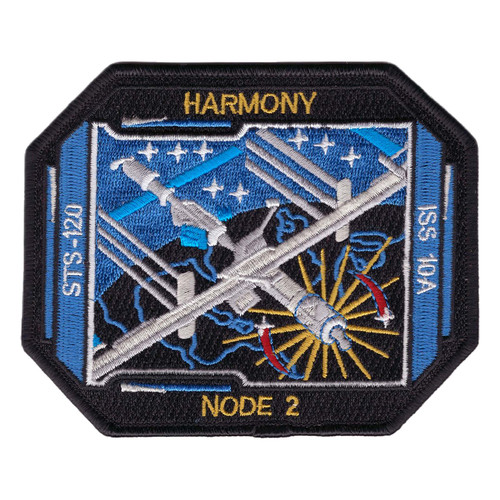
The patch is a stretched octagon with a rolled black merrowed border, with black bands carrying HARMONY across the top and NODE 2 along the bottom in gold. STS-120 and ISS 10A run along the light blue side panels. In the center the station's long silver truss cuts diagonally across a deep blue sky full of white stars, with the dark Earth below traced in blue coastlines. At the lower right a short cylindrical module sits in a burst of gold rays, two red arcs curving around it. It has an iron-on backing, and a few stitches around the border will keep it in place for good.
Harmony was built in Italy by Alcatel Alenia Space under a European Space Agency contract, with the Italian space agency ASI responsible for development, so it was fitting that an ESA astronaut from Italy rode up with it. With Harmony in place, the station had the hub it needed for Europe's Columbus laboratory, which arrived in February 2008, and for Japan's Kibo. The node also became a working base for the Canadarm2 robotic arm and an attachment point for the Multi-Purpose Logistics Modules. The STS-120 crew finished that assembly job and repaired a torn solar array on the same flight.
It fits a shadow box beside an STS-120 crew patch or an Expedition 16 patch, or on a jacket worn to a visit at Kennedy Space Center. It also makes a good gift for anyone who followed the station through its assembly years. Harmony still ties the station's laboratories together, and this patch remembers the flight that brought it up.
Related Products