
Special Operations Terminal Attack Controller Patch
- SKU:
- 9831
- MPN:
- 9831
- Width:
- 4.00 (in)
- Height:
- 4.00 (in)
- Depth:
- 0.08 (in)
- Backing:
- Iron On
- Edging:
- Merrowed Edge


Description
SOTACC is the Special Operations Terminal Attack Controller Course, taught at Yuma Proving Ground, Arizona, for special operations troops who will control aircraft from the ground. A joint terminal attack controller, a JTAC, is the qualified service member who directs combat aircraft in close air support and other offensive air operations from a forward position. Older hands knew the job as forward air controller, and most other countries still use that name. The course stood up in 2003 under the Army's John F. Kennedy Special Warfare Center and School. This patch carries both the course and the qualification it produces.
The joint community codified the job in Joint Publication 3-09.3 on 3 September 2003, setting the requirements for one person to direct the actions of combat aircraft engaged in close air support. In 2008 SOTACC moved from the Special Warfare Center and School to Air Force Special Operations Command's Special Tactics Training Squadron. Attendance is open to members of special operations units. A controller who is qualified and current is recognized across the Department of Defense as able and authorized to perform terminal attack control. The services also run their own JTAC pipelines, with the Air Force's 6th Combat Training Squadron at Nellis AFB, the Marine Corps Expeditionary Warfare Training Groups, and Navy JTAC training at NAS Fallon, Nevada.
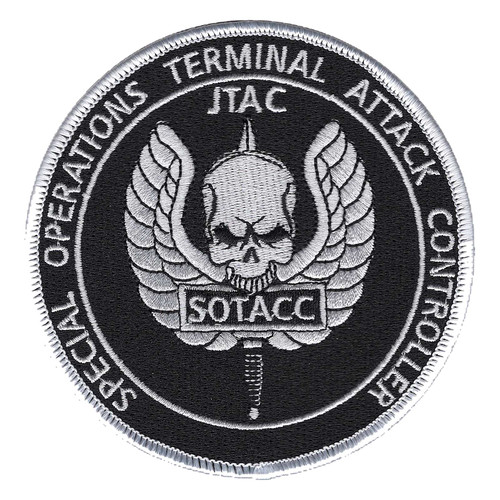
The patch is round, black twill with a white merrowed edge, lettered in silver-gray thread. SPECIAL OPERATIONS TERMINAL ATTACK CONTROLLER arcs around the outer ring, and JTAC sits at the top of the inner field. At the center a skull rests over a spread pair of upswept wings, with a dagger running straight through the middle, point up above the skull and grip below. A banner across the wings reads SOTACC. The black and gray scheme keeps it subdued, the way team gear tends to be marked.
Terminal attack control is where air power and the ground fight meet, and the controller carries the weight of every call he makes. He has to know the aircraft overhead, the weapon it is carrying, where friendly troops are and how close is too close, and he has to say it clearly on the radio while the fight is going on. On a special operations team the JTAC is the link between a small element on the ground and everything that can be brought down from above. SOTACC graduates go back to their teams carrying that responsibility. The skull and wings on this patch say how seriously the community takes it.
It measures 4 by 4 inches with a merrowed edge and an iron-on backing, and it can be sewn on as well. It fits a team room plaque, a range bag or a shadow box next to a JTAC qualification certificate. It also makes a good gift for a SOTACC graduate or a controller heading to Yuma. Anyone who has worked a radio with jets on station knows what the name on it means.
Related Products


