
POW MIA You Are Not Forgotten Yellow and Black Patch
- SKU:
- 5222
- MPN:
- 5222
- Width:
- 3.00 (in)
- Height:
- 4.00 (in)
- Depth:
- 0.08 (in)
- Backing:
- Iron On
- Edging:
- Merrowed Edge


Description
The bowed head in the silhouette belonged to Jeffrey Heisley, a 24-year-old Marine just home from basic training and still thin from a bout of hepatitis, and his father Newt drew him that way. Newt Heisley had flown C-47 transports over the South Pacific with the Army Air Forces in World War II. In 1971 a New Jersey agency handed him the job of designing a flag for its client, Annin & Company. The request had come from Mary Hoff, wife of a missing Navy officer, Lieutenant Commander Michael Hoff, through the National League of Families. The words YOU ARE NOT FORGOTTEN came to Heisley from his own memory of the fear of being taken prisoner and forgotten.
The League adopted the design in 1972, with its national coordinator Evelyn Grubb overseeing the work. The image is simple: a man in profile with his head bowed, a guard tower behind him and a strand of barbed wire below. In September 1982 the flag flew over the White House for the first time. On 10 August 1990, Public Law 101-355 recognized it as the symbol of the nation's concern and commitment to resolving the fates of Americans still missing. The National POW/MIA Flag Act, signed on 7 November 2019, requires it on certain federal properties on every day the United States flag is flown.
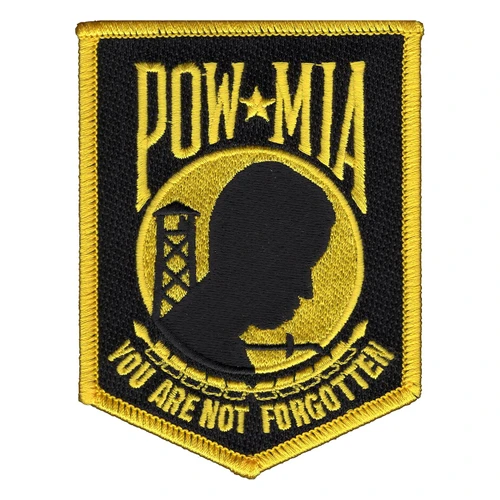
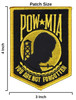
This version trades the flag's white on black for yellow on black. The patch is 3 inches wide by 4 inches tall, square across the top and pointed at the bottom, with a yellow merrowed edge. POW and MIA stand in tall yellow letters across the top with a small star between them. Below, a gold disc frames the black silhouette, the latticed guard tower on the left and the barbed wire running beneath, and YOU ARE NOT FORGOTTEN arcs along the bottom. The backing is iron-on, and it sews on just as well.
Heisley said years later that the flag was meant for a small group and that no one expected it to draw national attention. It drew far more than that. It hangs at VFW and American Legion posts, flies under the flag at courthouses and city halls, and rides on the back of motorcycle vests on every POW/MIA run. For families still waiting on an answer, it is a promise the country made out loud. For veterans, it is the reminder that nobody gets left behind.
It belongs on a riding vest, a jacket or a range bag, or in a shadow box beside a POW/MIA bracelet, a missing man's photo or the black and white version of the patch. It is also a meaningful gift for a veteran, a Gold Star family or anyone who stands up when the missing man table is set. You Are Not Forgotten, stitched where people can read it.
Related Products


