
POW MIA You Are Not Forgotten Red and Black Patch
- SKU:
- 5223
- MPN:
- 5223
- Width:
- 3.00 (in)
- Height:
- 4.00 (in)
- Depth:
- 0.08 (in)
- Backing:
- Iron On
- Edging:
- Merrowed Edge


Description
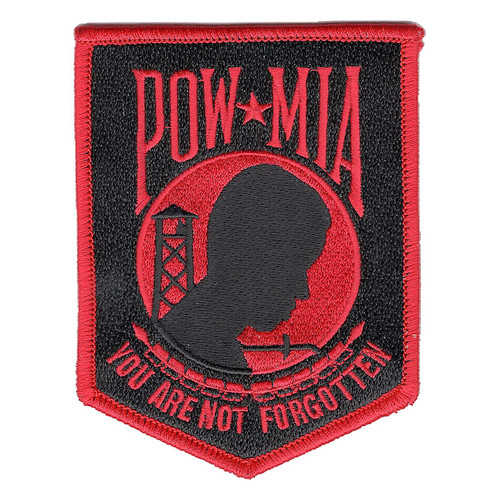
Black and white was not the only color scheme talked about for the POW/MIA symbol in 1971; red and white was discussed before the committee settled. This patch puts the same silhouette, guard tower and motto in red on black. Mary Hoff, whose husband, Navy Lieutenant Commander Michael Hoff, was missing in action, set the symbol in motion that year. Annin & Company took the job, Newt Heisley drew it, and the National League of Families adopted it in January 1972. More than fifty years on, the design still says one thing to everyone who sees it: somebody has not come home yet.
Heisley submitted three rough sketches to Mary Hoff, and her committee chose the one on the flag today. The gaunt profile was modeled on his son Jeff, just home from Marine boot camp and thin after a serious illness. The flag first flew over the White House in September 1982. Public Law 101-355, signed on 10 August 1990, recognized it as the symbol of the nation's commitment to resolving the fates of Americans still prisoner, missing and unaccounted for in Southeast Asia. The National POW/MIA Flag Act of 7 November 2019 requires it to fly every day the US flag flies at the Capitol, the White House, national cemeteries and VA medical centers. Heisley never copyrighted the design, because he wanted it to belong to all Americans.
This is a 3 by 4 inch patch cut like a pennant, square across the top and coming to a point at the bottom, finished with a red merrowed edge. POW and MIA stand across the top in tall red letters with a small red star between them. Below sits a red disc holding the black profile of a prisoner, head slightly bowed, with a guard tower at his shoulder and a strand of barbed wire curving under him. The tower and the wire are his prison. YOU ARE NOT FORGOTTEN runs along the bottom in red block letters, and the back is iron-on, so it presses onto a jacket or vest or can be stitched down for good.
The symbol stands for every American who went missing in the nation's wars and for the families who kept asking for answers. On a single pole it flies directly below the Stars and Stripes and never larger. Military dining halls often set a small table for one, the Missing Man Table, in honor of the missing. National POW/MIA Recognition Day is the third Friday in September, and the black flag goes up at posts, homes and public buildings that day. The red and black version carries the same promise in a darker palette that stands out on leather.
It sits well on a riding vest next to unit patches, or in a shadow box beside a POW bracelet or a photo of a relative still unaccounted for. It also makes a fitting gift for a veteran who flies the black flag at home and wants the red one on his jacket instead of the black and white patch. Press it on or sew it down. You are not forgotten, in red thread.
Related Products


