Patrol Wing FIVE (COMPATWING FIVE) Patch
- SKU:
- 12959
- MPN:
- 12959
- Width:
- 4.75 (in)
- Height:
- 4.00 (in)
- Depth:
- 0.08 (in)
- Backing:
- Iron On
- Edging:
- Cut Edge


Description
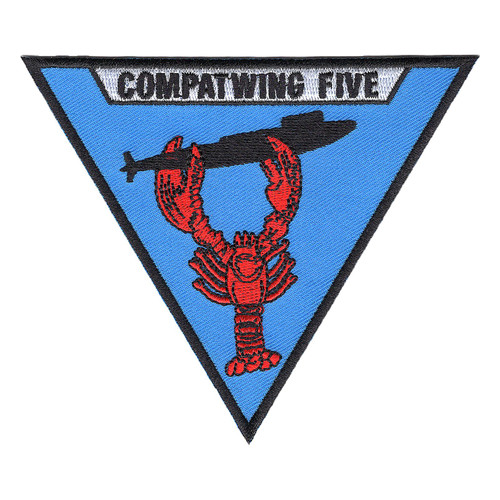
That red lobster has a submarine over its head, and for a patrol wing based in Brunswick, Maine, that says it all. COMPATWING FIVE hunted submarines from the Maine coast from the early 1970s until 2010. Its P-3 Orion squadrons flew long patrols over the North Atlantic and deployed to Iceland, Italy and Puerto Rico. The lobster is Maine, and the submarine caught in its claws is the job. The patch carries both on one blue triangle.
The wing traces to 1937, when Patrol Wing Five stood up at Norfolk with VP-14 and VP-15 flying PBY Catalinas. In 1941 VP-54 put the first operational radar on a Navy PBY, and in November 1942 the wing became Fleet Air Wing FIVE, moving on through PBM Marlins, PV patrol bombers and P2V Neptunes. The P-3A Orion arrived in 1962, and in 1966 its crews flew Vietnam patrols from Sangley Point in the Philippines. In 1973 the fleet air wings took back the Patrol Wing title, and at NAS Brunswick the wing took in VP-8, VP-10, VP-11, VP-23, VP-26 and VP-44. VP-23 supported Desert Shield, VP-8 flew Desert Storm sorties, and the squadrons flew over the Adriatic later in the 1990s. On 26 March 1999 it became Patrol and Reconnaissance Wing FIVE.
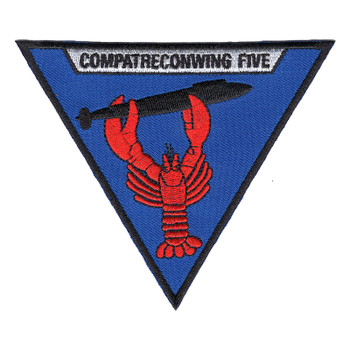
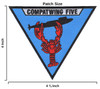
The patch is an inverted triangle 4.75 inches wide and 4 inches tall, with a cut edge and a black border. COMPATWING FIVE runs across the top in black block letters on a white panel. The field is a medium blue. A red lobster outlined in black rises from the point, both claws raised to hold a black submarine silhouette overhead. It reads from across a hangar: the sub found, caught and hauled out of the water.
Cold War patrol aviation was patient work, with ten-hour flights, sonobuoy patterns and long hours on a contact that might never surface. Crews from Brunswick spent much of their careers over cold water, rotating to Keflavik, Sigonella and Roosevelt Roads and coming home to Maine winters. The wing received its first P-3C AIP aircraft in January 1999 and flew the Update II and III Orions to the end. Its last squadrons moved to Jacksonville in December 2009, the last commodore hauled down the pennant in 2010, and NAS Brunswick closed in 2011. The P-3 crews who flew from Maine kept the Navy's antisubmarine watch in the Atlantic for a generation.
Press it onto a flight jacket or squadron jacket with the iron-on backing, and add a few stitches if it will see heavy wear. It fits a shadow box beside naval aircrew wings and a VP squadron patch, or the vest of a man who flew out of NAS Brunswick. It also makes a good gift for a P-3 veteran who still talks about winters on the Brunswick flight line. A lobster, a submarine and the wing's name, on one patch.
Related Products