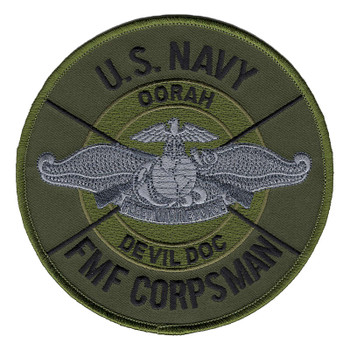
Navy Fleet Marine Force (FMF) Corpsman Patch
- SKU:
- 100263
- Width:
- 4.50 (in)
- Height:
- 3.25 (in)
- Depth:
- 0.08 (in)
- Backing:
- Iron On
- Edging:
- Merrowed Edge


Description
In a Marine platoon the corpsman is Doc, and the silver Fleet Marine Force device on his chest tells the Marines he has learned their trade on top of his own. This patch is built around that device. A Navy Hospital Corpsman assigned to the Marines lives, trains and moves with them, carries what they carry, and is the first one moving when someone goes down. The FMF qualification is the formal proof that he belongs there. Every Marine veteran who had a good Doc remembers his name.
The Navy Hospital Corps was signed into law by President William McKinley on 17 June 1898. In World War II corpsmen went ashore with the Marines in every Pacific beach assault, and in Korea they moved north with Marine rifle companies. During Vietnam, corpsmen bound for Marine units went through Field Medical Service School at Camp Lejeune or Camp Pendleton first, earning the old 8404 Field Medical Service Technician code. Today that training runs at the Field Medical Training Battalions at Camp Pendleton and Camp Johnson. The enlisted FMF warfare device was adopted in July 2000, and earning it takes a year with a Marine unit, the Combat Fitness Test, a written exam, hands-on skills like weapons breakdown and land navigation, and an oral board of FMF-qualified senior enlisted sailors.
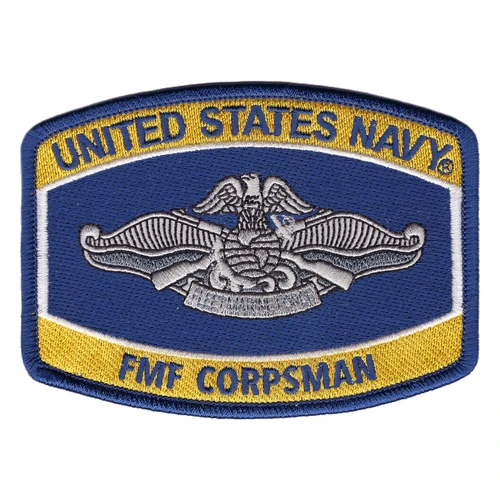
The patch measures 4.5 by 3.25 inches, with an arched top and bottom, a navy blue merrowed edge and an iron-on backing. UNITED STATES NAVY runs across a gold band at the top in navy letters, and FMF CORPSMAN fills the matching gold band at the bottom. The navy blue center, trimmed in white, carries the FMF device stitched in silver and gray. The eagle stands with spread wings over the globe and anchor for the Navy and Marine Corps team, two crossed rifles sit behind it for the rifleman's ethic, and breaking surf sweeps out to both sides for the beach where sea meets land, above a scroll reading FLEET MARINE FORCE.
Corpsmen are sailors who wear Marine uniforms in the field, and they carry two sets of traditions at once. Marines are hard on outsiders and harder on medics who cannot keep up, so the trust a Doc earns is earned on humps, ranges and patrols long before it is earned under fire. That bond is why so many Marine reunions still save a seat for their corpsman. The FMF device marks the sailor who closed that gap the formal way.
Mount it in a shadow box with a corpsman's ribbons and FMF pin, or iron it onto the jacket he wears to battalion reunions. It also makes a thoughtful gift for a Marine who wants to thank the Devil Doc who kept his platoon together. Navy blue, gold and silver, and every Marine will know exactly who it belongs to.
Related Products