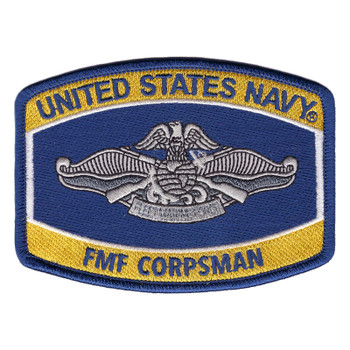
Fleet Marine Force Badge Patch
- SKU:
- 27292
- MPN:
- 27292
- Width:
- 4.25 (in)
- Height:
- 1.75 (in)
- Depth:
- 0.08 (in)
- Backing:
- Iron On
- Edging:
- Cut Edge


Description
The crossed rifles under the eagle, globe and anchor on the Fleet Marine Force badge are there because every Marine is a rifleman, and the sailor who earns this pin has proved he can keep up with them. The Fleet Marine Force warfare qualification belongs to Navy sailors serving with Marine Corps units. Hospital corpsmen wear it most often, and religious program specialists, the sailors who serve with Marine chaplains, earn it as well. The enlisted device is silver and the officer version is gold. The qualification replaced the old Fleet Marine Force Ribbon effective October 1, 2006.
Earning it is not a paperwork exercise. An enlisted sailor needs a year with a Marine unit, two for reservists, plus the Marine combat fitness test, a written exam, practical skills and an oral board. Besides corpsmen and RPs, logistics specialists, personnel specialists and Seabees assigned directly to Marine commands can qualify. On the officer side it goes most often to medical officers and chaplains, along with Civil Engineer Corps and naval gunfire officers. The Fleet Marine Force itself, the Marine Corps operating forces that deploy with the fleet, dates to 1933.
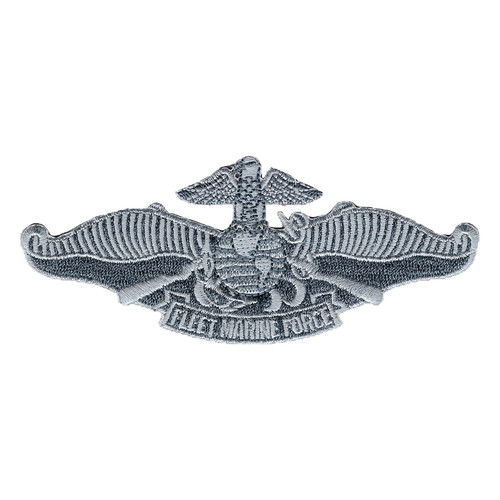
This patch is cut to the outline of the device, 4.25 inches wide and 1.75 inches tall, stitched entirely in silver and gray thread like the enlisted pin. The eagle stands on top of the globe, and the anchor's stock and fluke curve around it. Two crossed rifles run beneath. Breaking ocean swells on a sandy beach sweep out to either side like wings, and they stand for the littoral, the shoreline where sailors and Marines have fought side by side from Tripoli to Iwo Jima. A scroll along the base reads FLEET MARINE FORCE.
To a Marine, the corpsman is Doc, and that name carries more weight than any rank. Navy corpsmen have gone ashore with Marine rifle companies in every war of the last century, carrying aid bags where everyone else carried ammunition. Chaplains and RPs deploy with Marine units as well. The FMF badge is how the Navy recognizes that a sailor learned the Marine way of doing business and was trusted with Marines. Among the sailors who wear it, that trust is the whole point.
The iron-on backing lets it go onto a jacket, vest or range bag, and it can be sewn on for good. It fits in a shadow box beside a corpsman's caduceus, a set of dog tags and the unit patches from time with the Marines. It also makes a good gift for a Doc who served with a Marine unit. It is a simple, clear mark of a sailor who served on the green side.
Related Products