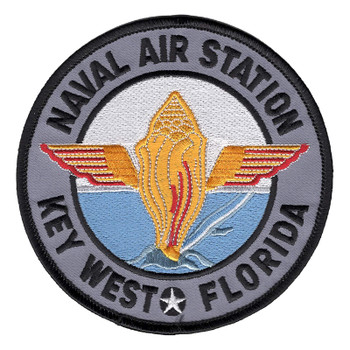
Naval Air Station Nas Key West Florida Patch
- SKU:
- 9878
- MPN:
- 9878
- Width:
- 4.00 (in)
- Height:
- 4.00 (in)
- Depth:
- 0.08 (in)
- Backing:
- Iron On
- Edging:
- Merrowed Edge


Description
The Navy has been at Key West since 1823, when a base went up on the island to put down the pirates working the Florida Straits. Aviation came almost a century later. Ground was broken for a coastal air patrol station on 13 July 1917, and the Naval Air Base was commissioned that December 18 with LT Stanley Parker as its first commanding officer. Today Naval Air Station Key West is an air-to-air combat training facility used by fighter squadrons of every service. Clear weather and open water off the Keys make it one of the places a fighter pilot comes to learn the merge.
The station went quiet after World War I and stayed that way until 1939. It was designated Naval Air Station Key West on 15 December 1940, just ahead of the war, and in March 1945 its satellite fields were folded into one command. On 22 October 1962 reconnaissance and operational flights in support of the Cuban blockade began from here. Fighter Composite Squadron 111, the Sun Downers, flies the F-5N and F-5F as the adversary, a job VF-45 handled earlier with A-4 Skyhawks, F-5E/F Tigers and F-16N Vipers. Strike Fighter Squadron 106 keeps a detachment at Boca Chica Field, and the old seaplane base lives on as the Trumbo Point Annex.
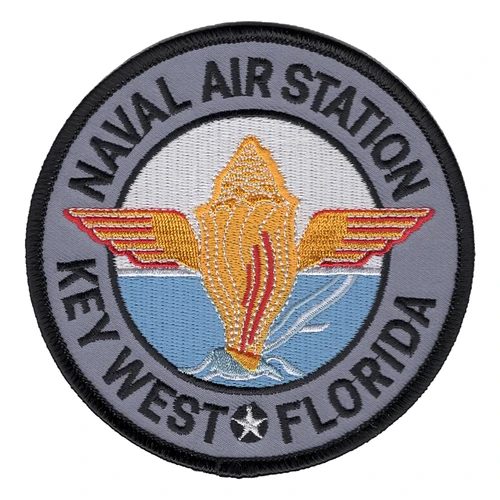
The patch is a round 4-inch piece with a black merrowed edge and a gray outer ring. NAVAL AIR STATION arcs across the top in heavy black letters, with KEY WEST and FLORIDA along the bottom, split by a single white star. In the center, a gold conch shell streaked with red bursts out of the water on a pair of spread gold wings. The conch is the island's own emblem, and Key West locals have called themselves Conchs for generations. The pale blue water and white sky give the whole design the light of the lower Keys.
Key West has been downgraded and restored. It became Naval Air Facility Key West on 5 October 2001 and was raised back to a full Naval Air Station on 1 April 2003. Through all of it the mission stayed the same: train aircrews to win in the air. Men who flew adversary, turned wrenches on a Tiger, or stood a watch at Truman Annex know the place for its heat, its runways and the ocean on every side. For a lot of fighter crews, the southernmost air station is where the training got real.
Put it in a shadow box beside your squadron and air wing patches, or sew it on the jacket you wear to a reunion. It also makes a good gift for a father or grandfather who flew out of Boca Chica. The patch has an iron-on backing and can also be sewn on.
Related Products