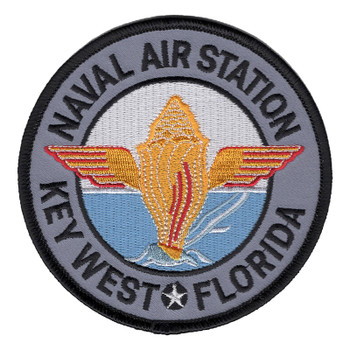
Naval Air Station NAS Key West Florida Large Version Patch
- SKU:
- 6769
- MPN:
- 6769
- Width:
- 4.50 (in)
- Height:
- 4.50 (in)
- Depth:
- 0.08 (in)
- Backing:
- Iron On
- Edging:
- Merrowed Edge


Description
The first naval flight out of Key West took off on 22 September 1917, a Curtiss N-9 seaplane flown by Coast Guard Lieutenant Stanley Parker. Three months later, on 18 December 1917, Naval Air Base Key West was commissioned with Parker as its first commanding officer. Ground had been broken for the coastal air patrol station at Trumbo Point that July. Training started on 18 January 1918, and by the end of World War I more than 500 aviators had trained there. That is where the long run of Navy flying at the bottom of the Keys began.
The air station and the submarine base closed in the 1920s, with only occasional seaplane training afterward, until the German submarine threat brought the Navy back. NAS Key West reopened on 15 December 1940. In World War II, Boca Chica Field was transferred to the Navy and became part of the air station, the field that is now Key West International Airport supported anti-submarine blimps, and a Sonar School opened at Truman Annex. On 22 October 1962, reconnaissance and operational flights began from Key West in support of the Cuban blockade during the Cuban Missile Crisis, and President John F. Kennedy later visited the base. In the 1970s the naval station closed, but NAS Key West stayed open and became a training facility for air-to-air combat for fighter aircraft from all services.
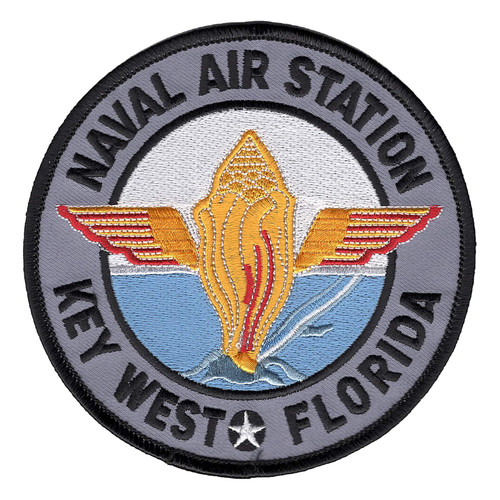
This is the large version of the patch, a 4.5 inch circle with a black merrowed edge. NAVAL AIR STATION arcs across the top of a gray ring in heavy black block letters, with KEY WEST FLORIDA along the bottom and a white star in a black roundel set between WEST and FLORIDA. In the center, a gold conch shell streaked with red rises out of light blue water against a white sky, with gold and red wings spread wide on either side. The conch is the island's own symbol, the name Key West natives have called themselves for generations, and the wings make it Navy air. A thin white trail sweeps off to one side like a jet climbing out over the water.
Key West has been a Navy town since 1823, and the air station carried that forward into the age of flight. It trained aviators in two world wars, watched the Florida Straits for submarines, and flew the Cuban blockade flights in October 1962. For decades fighter crews from every service came here to sharpen air-to-air skills over open water. Sailors who drew orders to Boca Chica remember the heat, the flight line and the sunset over the Gulf at the end of a long day. It is one of the oldest names in Naval aviation, and still flying.
The patch has an iron-on backing and a merrowed edge, and the larger 4.5 inch size makes it a strong center piece in a shadow box or on the back panel of a vest. It also makes a good gift for a sailor, aviator or maintainer who served a tour at NAS Key West, or for anyone who has flown in or out of Boca Chica. A gold conch with wings, and more than a century of Navy flying behind it.
Related Products