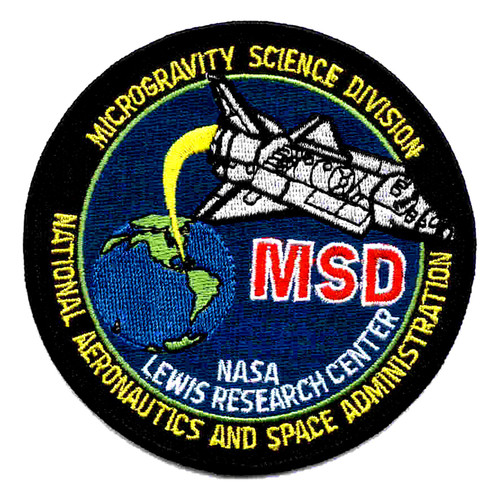
NASA Lewis Research Center Microgravity Science Division MSD Patch
- SKU:
- 8783
- MPN:
- 8783
- Width:
- 4.00 (in)
- Height:
- 4.00 (in)
- Depth:
- 0.08 (in)
- Backing:
- Sew On
- Edging:
- Merrowed Edge


Description
At NASA's Lewis Research Center in Cleveland, experiments fall for 5.18 seconds through a vacuum chamber inside a shaft that runs 510 feet into the ground. That is the Zero Gravity Research Facility, and a lot of Lewis microgravity research started there before it ever went to orbit. The Microgravity Science Division named on this patch carried that kind of work onto the Space Shuttle and toward the International Space Station. Its subjects were things that behave differently without gravity, flames and fluids above all. In 1999 Lewis was renamed the John H. Glenn Research Center at Lewis Field, so this patch carries the older name.
Lewis researchers ran early tests in the 2.2-second drop tower, in the Zero Gravity Facility and aboard a Learjet flying parabolic arcs for about 20 seconds of reduced gravity at a time. Experiments that proved out went to orbit on the shuttle, among them the Solid Surface Combustion Experiment, smoldering combustion and wire insulation flammability tests, and candle flames in microgravity. Combustion researchers planned their work around crew time on missions like USML-1, the first U.S. Microgravity Laboratory, which flew on Columbia as STS-50 in 1992. The division's Principal Investigator Microgravity Services project ran the International Microgravity Measurements Group meetings, where researchers reviewed measurements of the microgravity environment on the shuttle, Mir and sounding rockets. The 17th of those meetings met in Brook Park, Ohio, in March 1998.
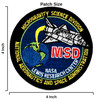
The patch is round, 4 inches across, with a black outer band carrying MICROGRAVITY SCIENCE DIVISION across the top and NATIONAL AERONAUTICS AND SPACE ADMINISTRATION around the bottom in yellow letters. A thin green ring frames a dark blue field. A white Space Shuttle orbiter crosses the upper right with its payload bay doors open and hardware visible inside. A yellow streak rises from North America on a blue and green globe up to the orbiter. Red MSD letters outlined in white sit at center right, with NASA and LEWIS RESEARCH CENTER in white below them.
Microgravity research is slow, careful work. A flame experiment could take years of drop tests and aircraft flights before it earned a few hours of crew time in orbit, and every result had to be read against the real acceleration environment on the vehicle. The people at Lewis did that work in Cleveland, far from the launch pads and Mission Control, in a program that paired combustion science with spacecraft fire safety. NASA has kept combustion and fluids research in Cleveland ever since. Under the Glenn name today, the center still runs the 2.2-second drop tower and the Zero Gravity Research Facility.
It fits a shadow box beside a Glenn Research Center or STS-50 patch, or the jacket of an engineer who spent the 1990s in Cleveland working on flames and fluids. It is also a good gift for anyone who knows exactly what a drop tower is for. The patch has a sew-on backing. It is a piece of Lewis history from before the Glenn name.
Related Products