NASA Flight Research Center Edwards AFB Patch
- SKU:
- 10502
- MPN:
- 10502
- Width:
- 4.50 (in)
- Height:
- 2.75 (in)
- Depth:
- 0.08 (in)
- Backing:
- Iron On
- Edging:
- Cut Edge


Description
From 1959 to 1976, the place NASA called the Flight Research Center ran the X-15, the lifting bodies and the Lunar Landing Research Vehicle at Edwards Air Force Base. It sits on the northwestern edge of Rogers Dry Lake in the Mojave, on the same lakebed where the NACA set up its Muroc Flight Test Unit in 1946. The Flight Research Center name came in 1959, the year after NASA took over from the NACA. On 26 March 1976 the center was renamed for Hugh L. Dryden, and on 1 March 2014 it became the Neil A. Armstrong Flight Research Center. This patch carries the name it went by for its first seventeen years under NASA.
The X-15 program made 199 flights between 1959 and 1968, a joint Air Force, Navy and NASA effort, with the rocket plane dropped from a B-52 at about 45,000 feet. The X-15A-2 reached Mach 6.7, 4,520 mph, in October 1967, and the program's ceiling was 354,200 feet, about 67 miles up. Eight of its twelve pilots were awarded astronaut wings. The M2-F1, the first lifting body, flew here, and wingless shapes like the HL-10 followed it off the lakebed. In the mid-1960s the center tested the Lunar Landing Research Vehicle, and the trainers that grew out of it were what Apollo astronauts practiced on as their launch dates closed in. On 25 May 1972, research pilot Gary Krier took a modified F-8C Crusader up on the first flight of the digital fly-by-wire program, run jointly with Langley.
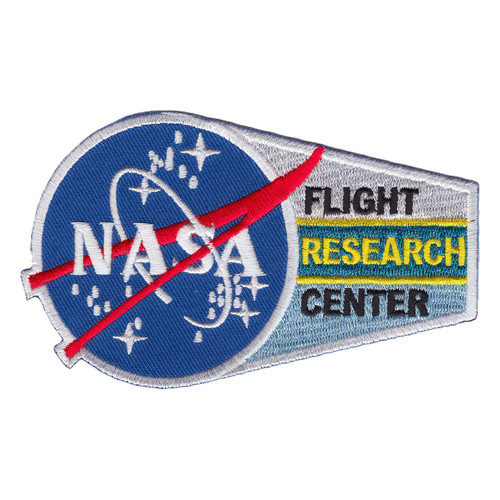
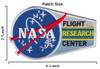
The patch is 4.5 inches wide and 2.75 inches tall, cut to a teardrop outline that tapers to the right, with a white stitched border following every curve. The round blue NASA insignia fills the left end, with white NASA lettering, white stars, a white orbit ring and the red vector, whose tips poke out past the circle. That red chevron is a wing shape, the part of the insignia that stands for aeronautics, which suits a center built for flight research. To the right, FLIGHT is stitched in black on silver, RESEARCH in gold on a teal band between thin gold stripes, and CENTER in black on light blue. It has an iron-on backing, and a few stitches around the border will keep it in place for good.
Edwards was where NASA found out what wind tunnels could not tell it, by putting pilots in the airplanes. Paul Bikle directed the center from September 1959 to May 1971, through the X-15 years and the first lifting body flights. Neil Armstrong was a research test pilot there from 1955 to 1962 and made seven flights in the X-15 before he went on to Gemini and Apollo. The pilots, engineers and crew chiefs of those years took rocket planes past Mach 6 and to the edge of space from a dry lakebed in the desert. When the center took Armstrong's name in 2014, it honored one of its own.
It fits a shadow box with an X-15 or lifting body photo, or the jacket you wear to an Edwards reunion. It is also a good gift for someone who worked at Dryden or Armstrong and wants the name the center carried before them. Seventeen years of flight research on Rogers Dry Lake, on one patch.
Related Products