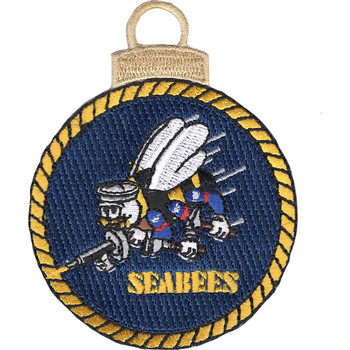
US Navy Seabees Construction Battalion Bee Patch

- SKU:
- 6180
- MPN:
- 6180
- Width:
- 4.50 (in)
- Height:
- 4.50 (in)
- Depth:
- 0.08 (in)
- Backing:
- Iron On
- Edging:
- Cut Edge


Description
The Seabee started as a sketch by Frank Iafrate, a civilian clerk at Naval Air Station Quonset Point, who first thought about a beaver and threw it out because a beaver does not fight. In early 1942 Lieutenant Shilstone asked him for a cartoon character to stand in for the clumsy name Construction Battalion. Iafrate chose a bee, a hard worker that defends what it builds. He put it in a Navy white sailor's dixie cup, and the initials C and B became Seabees. On March 5, 1942 the Bureau of Navigation approved the name, and Rear Admiral Ben Moreell's Bureau of Yards and Docks adopted the bee for every battalion.
Moreell had asked for authority to form naval construction units on December 28, 1941, three weeks after Pearl Harbor, to replace civilian workers lost on Wake, Guam and the Philippines. By the end of World War II, 325,000 men had enlisted in the Seabees, and they built more than 400 advanced bases across the Atlantic and Pacific. On D-Day, Seabees of the naval combat demolition units were among the first ashore at Normandy, blowing steel and concrete obstacles alongside Army engineers. From 1955 they wintered in Antarctica for Operation Deep Freeze and built an ice runway on McMurdo Sound. In Vietnam, Construction Mechanic Third Class Marvin G. Shields became the first Seabee and the first Navy man awarded the Medal of Honor for action in that war.
The patch is a 4.5-inch circle with a cut edge and an iron-on backing. A gold twisted rope runs around a royal blue field, the hawser that replaced the letter Q for Quonset Point in the first version of the design. The bee flies left with speed lines behind him, white wings up and a determined scowl under his white dixie cup. His front hands hold a submachine gun for the fighting half of the job, and the others grip a hammer and a wrench for the building half. SEABEES is stitched in gold stencil lettering, the style that replaced the original Roman letters.
Every detail on the bee was chosen to say We Build, We Fight, the English for Moreell's Latin motto Construimus, Batuimus. Seabees have answered to Can Do for just as long. Equipment operators, builders, steelworkers, utilitiesmen and construction mechanics all wear the same bee, from Quonset huts in the Pacific to airstrips and camps in the desert. Many of the first recruits had already built Boulder Dam, highways and shipyards before they ever put on a uniform. The bee has stayed nearly the same for more than 80 years.
Sew it on the vest you wear to battalion reunions, or frame it in a shadow box with your NMCB and battalion patches. It also makes a good gift for a Seabee's son or daughter who grew up hearing the stories. Can Do.
Related Products