Mobile Construction Battalion Seabees Patch Desert

- SKU:
- 6181
- MPN:
- 6181
- Width:
- 4.25 (in)
- Height:
- 4.50 (in)
- Depth:
- 0.08 (in)
- Backing:
- Iron On
- Edging:
- Cut Edge


Description
The bee on this patch was drawn in early 1942 by Frank Iafrate, a clerk at Naval Air Station Quonset Point, and it has not put its tools down since. Iafrate first tried a beaver and threw it out, because a beaver does not fight. He wanted a bee, an animal that works hard all day and can defend itself when bothered. The name came from the letters CB, for Construction Battalion, and the Seabees designation was approved on 5 March 1942. The bee was drawn for the First Naval Construction Battalion and was soon adopted for every battalion that followed.
The desert field on this version belongs to the Seabees of Southwest Asia. Iraq invaded Kuwait on 2 August 1990, and 210 Seabees of Amphibious Construction Battalion 1 were in Saudi Arabia by 13 August. By early February 1991, 2,800 Seabees and 1,375 pieces of equipment were in theater, with NMCB 1, 4, 5, 7, 24, 40 and 74 under the 3rd Naval Construction Regiment. They built aprons and base camps at four airfields, ammunition supply points, camps for the 3rd Marine Aircraft Wing and the 1st and 2nd Marine Divisions, and a headquarters complex for I Marine Expeditionary Force. For II MEF they put up a 15,000-man camp the Marines called Wally World. When the End Run plan needed more than 200 miles of road near the Kuwaiti border, the Seabees finished the work in about two weeks.
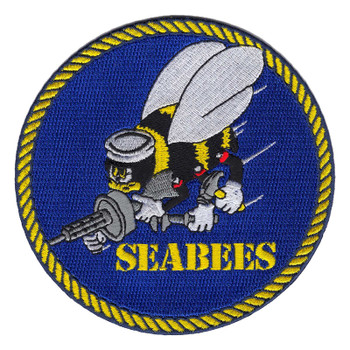
The patch is 4.25 by 4.5 inches, a circle set on a rectangular tab, with a cut edge trimmed to the combined outline. Sand, tan and brown camouflage blotches fill both the circle and the tab. The Fighting Bee is worked in brown thread alone, in subdued colors so it sits right on a desert uniform. The details are all there: the sailor's white Dixie cup on his head, the submachine gun for fighting, the hammer and wrench for building. SEABEES runs across the tab below in heavy brown block letters.
The Seabees in the desert worked seven days a week in two 12-hour shifts, and the only days off were Thanksgiving and Christmas. August heat reached about 120 degrees, and the sand chewed through equipment as fast as the mechanics could fix it. The Marines who lived in those camps and drove those roads knew who had built them. We Build, We Fight is the Seabee motto, and the desert battalions lived it. A Seabee who served in Southwest Asia will recognize this patch as his own.
Frame it in a shadow box with an NMCB deployment patch and a photo from the camp, or sew it onto the jacket that goes to the battalion reunion. It also makes a good gift for the Seabee in the family who still talks about the heat. The backing is iron-on, and it takes a needle just as well if you would rather sew it. Can Do.
Related Products