Milstar-6 USA-169 Titan IVB-35 Cape Canaveral Launch Patch

- SKU:
- 8809
- MPN:
- 8809
- Width:
- 3.75 (in)
- Height:
- 3.75 (in)
- Depth:
- 0.08 (in)
- Backing:
- Sew On
- Edging:
- Merrowed Edge


Description
Titan IVB-35 launched from Cape Canaveral at 9:43 a.m. Eastern on 8 April 2003 and put the last Milstar II satellite into orbit, completing the Milstar constellation. The satellite was the sixth Milstar launched, flight DFS-6, and it went into the catalog as USA-169. It joined four working Milstars already in orbit. Milstar was built for secure, jam-resistant communications worldwide, linking command authorities with ships, submarines, aircraft and ground stations. Lt. Col. Tony Cotton, commander of the 3rd Space Launch Squadron, called it "a critical communication asset for each branch of the military."
The rocket was a Titan IV(401)B with a Centaur upper stage, Centaur TC-23, flying from Space Launch Complex 40. About six and a half hours after liftoff the Centaur released the satellite on its way to geosynchronous orbit. It was the 35th Titan IV launch, 24 of them from the Cape and 11 from Vandenberg, and only four Titan IVBs were left to fly after it. Lockheed Martin built both the Titan IV and the Milstar satellites. The Block II Milstars like this one added a medium data rate channel, up to 1.544 megabits per second, on top of the low data rate service of the first two. Every Milstar flew from SLC-40 on a Titan IV with a Centaur on top.
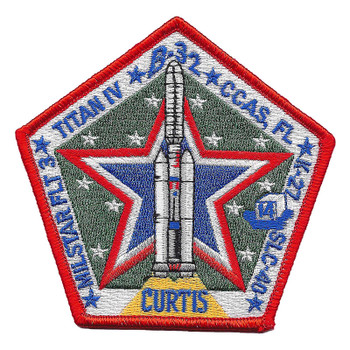
The patch is a pentagon, point up, about 3.75 inches across, with a red merrowed border and a red band. A gold star sits at the top point and white stars sit at the other four corners. The band carries CX-10 and TC-23 across the top, MILSTAR-6 down the left, TITAN IVB-35 down the right and SELFRIDGE along the bottom. Inside, a black triangle holds the white Titan IVB with its two big side boosters, the Air Force wing-and-star symbol and CCAFS. A black centaur draws his bow on the left, and the upper stage on this flight was a Centaur. On the right a yellow satellite spreads its solar arrays, and the patch has a sew-on backing.
Milstar had a hard road to completion. The third satellite, launched in 1999, was left in a useless orbit when a database error threw off its Centaur's attitude control, and it was switched off after ten days. Two more Block II satellites followed in 2001 and 2002, and Titan IVB-35 closed the program out with this one. For the launch crews at the Cape, the satellite builders and the operators who flew the constellation, this was the flight that finished the job. In August 2010, control of the Milstar system passed to the Advanced Extremely High Frequency program.
Put it in a shadow box with other Titan IV and Cape Canaveral launch patches, or on the jacket of someone who worked SLC-40 or the Milstar program. It is also a good gift for a space launch veteran or a satcom operator who used the system. It is the patch for the last Milstar.
Related Products