Milstar Flight 4 Titan IVB B-41 GUS LC-40 Launch Patch

- SKU:
- 10468
- MPN:
- 10468
- Width:
- 4.00 (in)
- Height:
- 4.00 (in)
- Depth:
- 0.08 (in)
- Backing:
- Iron On
- Edging:
- Merrowed Edge


Description
Titan IVB vehicle B-41 left Complex 40 at Cape Canaveral at 4:20 in the afternoon on February 27, 2001, carrying Milstar Flight 4. The satellite was cataloged as USA-157 and is also known as DFS-4. It was a Block II Milstar, and the Block II satellite before it had been left in a useless low orbit by an upper stage problem in April 1999. That made B-41 the launch that put the first working Block II satellite into the constellation. The name GUS is stitched across the top of this patch.
Milstar, the Military Strategic and Tactical Relay system, was built to give U.S. forces secure, jam-resistant communications. The Block II satellites added a medium data rate payload, from 4.8 kilobits to 1.544 megabits per second, on top of the low data rate service of the first two. B-41 flew in the 401B configuration, a Titan IVB with a Centaur upper stage to carry the satellite up toward geosynchronous orbit. All six Milstars launched from Complex 40, the LC-40 on the patch, and Flights 5 and 6 followed on January 15, 2002 and April 8, 2003. Control of the system passed to the Advanced Extremely High Frequency program in August 2010.
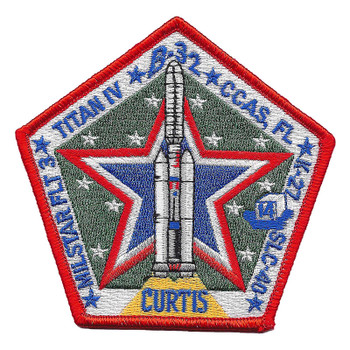
The patch is a 4 inch octagon with a rolled black merrowed border and a black band lettered in gold: GUS at the top, TC22, LC-40 and FLIGHT 4 down the right, and MILSTAR, TITAN IVB and K-30 up the left. Inside, a white Titan IVB with red and blue bands stands on a green hill against a deep blue sky ringed with white stars, with B-41 on a gold plaque at its base. A Milstar satellite with blue panels floats at the upper left. To the right is the black outline of a Mercury capsule marked with a 7, the number every crewed Mercury capsule carried in its name. Lower left, a dotted white cloud reads JOHN under a small box marked 27, and a single open white star sits on the hill. It has an iron-on backing, and a few stitches will keep it in place.
Titan launch teams named their rockets, and their patches are full of references only the crew could fully explain. TC22 follows the numbering used for the Titan Centaur upper stages that rode on top. Milstar had a hard road to completion, and after the 1999 loss every launch that followed carried extra weight. B-41 got a Block II satellite where it needed to be and set up the two Milstar launches that finished the job. For the people who stacked and launched it at Complex 40, GUS was the one that got the program moving again.
It fits a shadow box with the Milstar Flight 5 and Flight 6 Titan IVB patches, or on the jacket of someone who worked Complex 40 in the Titan years. It is also a good gift for an Air Force veteran who worked military satellite communications. One rocket, one satellite, and a Mercury capsule along for the ride.
Related Products