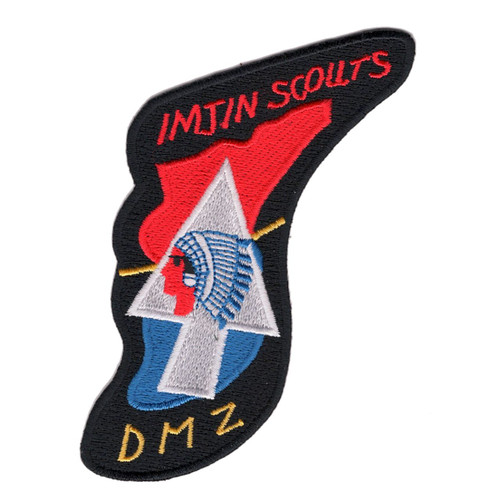
Imjin Scouts DMZ Korea 2nd Infantry Division Embroidered Patch
- SKU:
- 685
- MPN:
- 685
- Width:
- 3.00 (in)
- Height:
- 4.00 (in)
- Depth:
- 0.08 (in)
- Backing:
- Iron On
- Edging:
- Cut Edge




Description
The Imjin Scout designation was not awarded — it was walked for, patrol by patrol, in the strip of ground between the southern barrier fence and the Military Demarcation Line where the Korean War never ended. Soldiers assigned to the 2nd Infantry Division who completed DMZ patrols along the Imjin River corridor qualified for the title, and within the Division it carried a specific gravity that no other stateside or peacetime assignment could replicate. The 2nd Infantry Division — the Indianhead Division — has held the line on the Korean Peninsula since 1950, and the Imjin Scouts were the soldiers standing closest to the edge of that commitment at any given moment.
The Division's area of operations stretched across the terrain north of Seoul toward the DMZ, with major installations at Camp Casey near Dongducheon, Camp Hovey, and Camp Howze forming the backbone of the forward presence. Soldiers patrolled in all conditions through terrain that mixed rice paddies, ridgelines, and river crossings, operating under rules of engagement shaped by decades of armistice tension. The Imjin Scout program formalized recognition of that forward patrol duty, acknowledging that the men walking that ground in any given year — whether it was 1968, 1976, or 1988 — were doing something that most of the Army was not. The Division's organic firepower during the Cold War era included M60 Patton tanks, M113 armored personnel carriers, and M198 howitzers positioned to respond to any breach of the MDL, and the scouts patrolled in front of all of it.
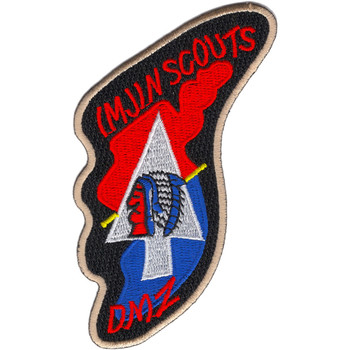
The patch takes a distinctive freeform shape trimmed close to the embroidery with a cut edge, giving it a clean, sharp profile that sets it apart from standard rectangular or oval designs. The black field frames the 2nd Infantry Division's arrow-point-up insignia split into a red upper half and blue lower half, with the Division's Indian Head profile centered on a silver-gray triangle at the arrowhead. Two crossed gold lances cut across the center of the arrow — a direct reference to the Scout mission and the Division's heritage. "IMJIN SCOUTS" arches across the top in red lettering, and "DMZ" is stitched in gold across the bottom. Iron-on backing makes it straightforward to apply, and it can also be sewn on for a permanent hold on any fabric.
The 2nd Infantry Division is the only continuously forward-deployed combat division in the U.S. Army, and that distinction is inseparable from the men who pulled DMZ patrol duty through the Cold War's most volatile decades. In the aftermath of the 1976 axe murder incident at Panmunjom and the ongoing infiltration tunnels discovered throughout the 1970s, the soldiers walking the Imjin corridor were not running training exercises. The Imjin Scout designation acknowledged that reality plainly. It still does. For Korea veterans who know exactly what it means to stand that watch, this patch is a direct marker of that service.
It mounts cleanly in a shadow box alongside 2nd Infantry Division unit crests, Korean Service ribbons, and photos from Camp Casey. It belongs on a veteran's vest at Division reunions or affixed to a range bag. For a son or daughter trying to find something that honors where their father was actually stationed, this patch says it without needing a caption.
Related Products