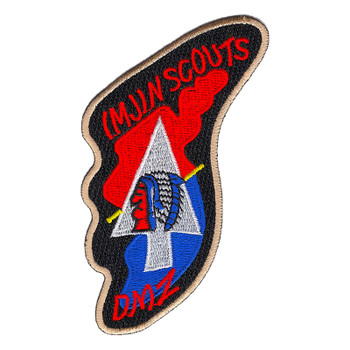
Imjin Scout DMZ Subdued Patch

- SKU:
- 12921
- MPN:
- 12921
- Width:
- 3.00 (in)
- Height:
- 4.50 (in)
- Depth:
- 0.08 (in)
- Backing:
- Iron On
- Edging:
- Cut Edge


Description
Under a 1967 2nd Infantry Division regulation, the Imjin Scout patch with DMZ beneath the title took twenty operational missions along the Demilitarized Zone. The name came from the Imjin River, which flows out of North Korea into the South. The ground north of it was where the 2nd Infantry Division held the American sector of the DMZ. From 1965 until 1991, small teams of Indianhead soldiers patrolled that sector year round, watching for infiltration and answering North Korean provocations fast. Men who had twenty missions behind them called themselves Imjin Scouts.
The first version of the patch, worn from 1965 to 1967, carried no DMZ line; the subtitle was added in early 1967 and stayed through 1991. Teams ran about ten men on three-month rotations, roughly nine in ten of them American and the rest KATUSA soldiers, the Korean Augmentation to the U.S. Army. Through the late 1960s clashes along the zone came close to daily, and in 1968 a 31-man North Korean unit crossed into the South in an attempt on President Park Chung-hee. Retired sergeant Mark Heathco ran 385 DMZ patrols and wrote about them in Call Sign Purple Three, and Daniel P. Bolger covered the 1966 to 1969 fighting in Scenes from an Unfinished War. The mission passed to the Korean Army in October 1991.
This is the subdued version, 3 inches wide and 4.5 inches tall, with a cut edge that follows its irregular outline and a thin black border. The field is charcoal gray, and an olive drab map of the Korean peninsula runs up through it. On the map sits a gray arrowhead outlined in black, and on the arrowhead is the Indianhead, a warrior in a feathered war bonnet stitched in olive. A fine line crosses the peninsula and the arrowhead at the warrior's level, where the full-color version puts the dividing line between North and South. IMJIN SCOUTS curves along the top in black and DMZ sits at the bottom.
Imjin Scouts came from across the division, infantrymen and attached soldiers who took their turn north of the river in every season. The war along that line had never formally ended, and in Korea the fighting of the late 1960s is sometimes called the Second Korean War. Moon Kwan-hyun, the only Korean on the final DMZ team in the summer of 1991, calls himself the last Imjin Scout, and his book Imjin Scouts came out in 2022. He walked about thirty patrols between June and August that year before the sector changed hands. For the men who wore this patch, twenty missions was the price of entry, and nobody had to explain it twice.
It sits well in a shadow box next to an Indianhead combat patch and a Korea Defense Service Medal, or on a field jacket worn to a 2nd Infantry Division reunion. It is also a good gift for a son or grandson who has heard the DMZ stories and never seen the patch. The backing is iron-on, and it takes a needle fine if you want it permanent. Twenty missions north of the Imjin, in thread.
Related Products