
First Filipino Unit Patch WWII
- SKU:
- 4977
- MPN:
- 4977
- Width:
- 3.25 (in)
- Height:
- 3.25 (in)
- Depth:
- 0.08 (in)
- Backing:
- Iron On
- Edging:
- Cut Edge
- Era:
- World War II



Description
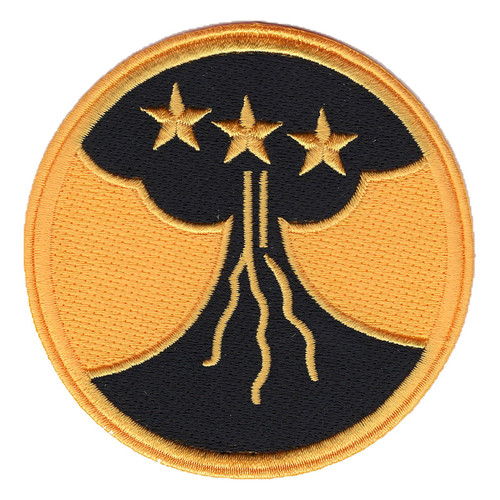
The 1st Filipino Infantry Regiment wore a black volcano on a gold disc with three gold stars across its smoke, and went to war under the motto Laging Una, "Always First." Its soldiers were Filipino Americans, and for many of them the Pacific war was personal, because the Philippines was under Japanese occupation. A battalion was activated at Camp San Luis Obispo, California, in April 1942. On 13 July 1942 it was raised to a full regiment at the California Rodeo Grounds in Salinas. Its first commander, Colonel Robert H. Offley, was picked in part because he spoke Tagalog.
The regiment went to Camp Beale, while the 2nd Filipino Infantry Regiment, activated at Fort Ord in November 1942, went to Camp Cooke. At Camp Beale about 1,200 soldiers were sworn in as American citizens in one mass naturalization ceremony. In 1944 the 2nd Regiment was broken up to bring the 1st to 125 percent of its normal strength, and the men left over formed the 2nd Filipino Infantry Battalion (Separate). The regiment sailed in April 1944 aboard USS General John Pope for Oro Bay, New Guinea, and was attached to the 31st Infantry Division under Eighth Army. In February 1945 it went to Leyte with the Americal Division and X Corps and carried out mopping-up operations on Leyte, Samar and other islands of the Visayas, while some of its men served with the Alamo Scouts and the 5217th Reconnaissance Battalion.
This is a 3.25 inch round patch, a gold disc with a matching gold border. A black, stylized volcano climbs from the bottom edge and opens into a wide black cloud of smoke. Three gold stars run in a line across the top of the cloud, and thin gold lines trace the smoke and lava down the slope. Three is also the number of stars on the Philippine flag, though we found no record spelling out what the regiment meant by them. There is no lettering, just the volcano and the stars, the way the men wore it on the shoulder.
For Filipino American families, this regiment is a point of pride passed from one generation to the next. Many of its men took the oath of citizenship in uniform at Camp Beale. They went back to the Philippines as American soldiers, and some companies also fought on Bataan and Corregidor. The regiment came home aboard USS General R. E. Callan on 8 April 1946 and was deactivated two days later at Camp Stoneman. The volcano and the three stars are what they wore through all of it.
It belongs in a shadow box next to a grandfather's discharge papers and a photo from Camp Beale, or on a jacket worn to a Filipino American history event. It is also a good gift for a family member whose lolo served in the regiment. The iron-on backing presses onto a jacket or tote, and a few stitches around the edge make it permanent. Always first, from Salinas to Samar.
Related Products


