
WWII Rangers Patch
- SKU:
- 42
- MPN:
- 42
- Width:
- 3.25 (in)
- Height:
- 2.00 (in)
- Depth:
- 0.08 (in)
- Backing:
- Iron On
- Edging:
- Cut Edge
- Era:
- World War II




Description
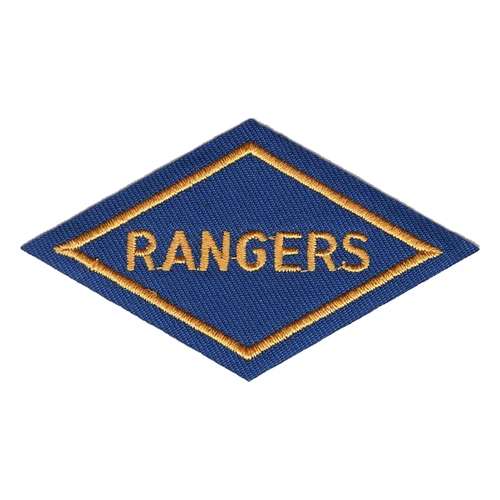
The men who climbed Pointe du Hoc on 6 June 1944 wore this blue diamond on their shoulders, not the black and gold scroll most people picture. The Army approved the blue Ranger lozenge for all Ranger battalions on 26 July 1943, but in practice only the 2nd and 5th Ranger Battalions wore it. They wore it in training stateside and they wore it onto the Normandy coast. Later in the war both battalions set it aside for unofficial scrolls patterned on the 1st Ranger Battalion's design. Collectors call it the Ranger diamond, and to anyone who has studied D-Day it points straight at two battalions.
The 2nd Ranger Battalion formed on 1 April 1943 at Camp Forrest, Tennessee. On D-Day, Dog, Easy and Fox Companies under Lt. Col. James Earl Rudder landed at Pointe du Hoc and destroyed a battery of captured French 155mm guns positioned to fire on Utah Beach. Able, Baker and Charlie Companies went in at Omaha Beach with the 5th Ranger Battalion and the 1st and 29th Infantry Divisions, and Able Company took casualties as high as 96 percent. The battalion fought at Brest that summer, then led the assault on Hill 400 at Bergstein during the Battle of Hurtgen Forest. The scroll the Rangers switched to later became the pattern the 75th Infantry Regiment adopted in 1984, two years before it was redesignated the 75th Ranger Regiment.
This patch is 3.25 inches wide and 2 inches tall, a flat diamond of royal blue twill with a gold border stitched just inside the cut edge. RANGERS runs across the center in gold block letters. There is no tab, no number and no scroll on it, and that plain layout is what makes it read as 1943 to anyone who knows the period. The backing is iron-on, and it takes a needle just as well if you want it stitched down for good.
The diamond belongs to a short window, from the summer of 1943 into the fighting across France, and no Ranger device is tied more closely to the cliffs at Pointe du Hoc. Rudder's companies went up those cliffs under fire and held the ground on top. The Rangers who landed at Omaha the same morning paid as heavily as any unit on the beach. Ranger veterans and their families still know the blue diamond at a glance. It is a piece of Army history with a date and a place attached.
It fits a shadow box with a grandfather's discharge papers, a photograph in uniform and a framed map of the Normandy coast. It also sits well on a jacket or vest worn to a D-Day commemoration, and it makes a meaningful gift for the son or granddaughter of a man who served in the 2nd or 5th Rangers. A small patch, with a very specific morning behind it.
Related Products


