Cassini Titan IV B-33 Saturn Launch Patch
- SKU:
- 8754
- MPN:
- 8754
- Width:
- 5.00 (in)
- Height:
- 4.00 (in)
- Depth:
- 0.08 (in)
- Backing:
- Iron On
- Edging:
- Merrowed Edge


Description
Titan IV B-33 left Launch Complex 40 at Cape Canaveral before dawn on October 15, 1997, carrying the Cassini spacecraft and its Huygens probe toward Saturn. Cassini was the only civilian mission on the Titan IV manifest, which otherwise carried military and intelligence payloads. Only one Titan IVB had launched before it. With a Centaur upper stage on top, the vehicle stood 55.8 meters tall and weighed about 1,038,000 kilograms at liftoff with Cassini aboard. The spacecraft belonged to NASA, the European Space Agency and the Italian Space Agency, and this patch is for the rocket that got it off the ground.
Cassini separated from the Centaur 42 minutes and 40 seconds after liftoff, and the launch put it within one part in five thousand of its target energy. It then took the long way out, with Venus flybys in April 1998 and June 1999, an Earth flyby in August 1999 and a pass by Jupiter in December 2000. It entered orbit around Saturn on July 1, 2004 (UTC), and Huygens landed on Saturn's moon Titan on January 14, 2005. The orbiter, named for astronomer Giovanni Domenico Cassini, worked at Saturn until September 15, 2017, when it was sent into the planet's atmosphere. Its power came from radioisotope thermoelectric generators, and NASA had White House approval to launch on October 3, 1997.
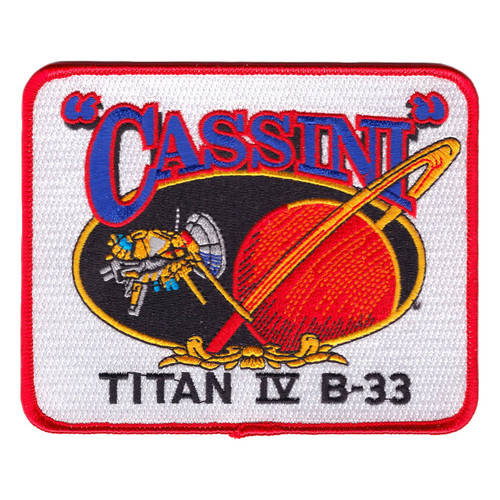
This is a rectangle with rounded corners, 5 by 4 inches, with a red merrowed border around a white field. CASSINI arches across the top in blue letters outlined in red, set inside quotation marks. Below it, the gold and silver Cassini spacecraft, high-gain dish forward, crosses a black oval toward a red-orange Saturn circled by a gold ring. A gold scroll sits under the planet, and TITAN IV B-33 is stitched in black across the bottom. It has an iron-on backing, and stitching around the border after pressing will keep it in place for good.
Launch teams number their rockets, and B-33 is the number on the one that sent Cassini on a seven-year trip to Saturn. Everything the mission found in thirteen years there, from the rings up close to the surface of Titan, started with this liftoff from the Cape. The launch drew protests over the plutonium in the power supplies, and the crews worked through it and flew on the second try after weather slipped the first date. For the people who stacked and launched B-33 at Complex 40, this is their part of the Cassini story.
It fits a shadow box with a photo of the Titan IVB on the pad, or a display of Cape Canaveral launch patches from the 1990s. It is also a good gift for anyone who followed Cassini from launch to the Grand Finale in 2017. One rocket, one night launch, and twenty years of Cassini.
Related Products