
Assault Boat Coxswain Patch
- SKU:
- 14163
- MPN:
- 14163
- Width:
- 2.00 (in)
- Height:
- 2.00 (in)
- Depth:
- 0.08 (in)
- Backing:
- Iron On
- Edging:
- Cut Edge


Description
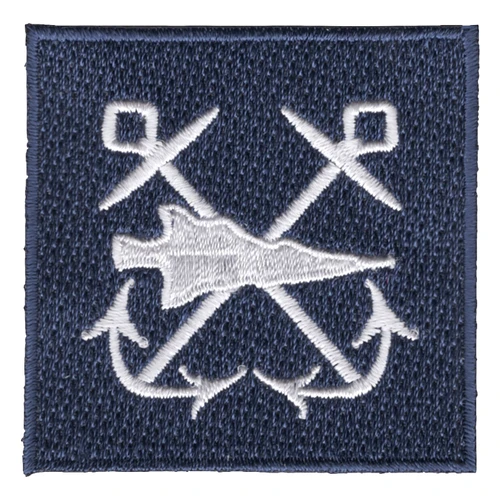
Two crossed anchors with an arrowhead laid across them is the Navy distinguishing mark for an assault boat coxswain, the enlisted sailor who drove a landing craft onto a defended beach. Every amphibious landing ran on these men. The troops rode in the well of the boat, and the coxswain stood at the stern with the wheel and the throttle. He brought them in through surf and fire, dropped the ramp, and backed off to go get the next wave. It was a boat handler's job done under the worst conditions a boat handler can face.
The work came into its own in World War II. The LCVP, the Landing Craft, Vehicle, Personnel that sailors called the Higgins boat, carried a platoon of infantry or a jeep, and its coxswain had to hold his place in a boat wave timed to the minute. At Normandy on June 6, 1944, Navy and Coast Guard coxswains put the first assault waves ashore at Omaha and Utah beaches. In the Pacific they did the same at Tarawa, Saipan, Iwo Jima and Okinawa, often crossing reefs that could hang a boat up short of the sand. Larger landing craft such as the LCM carried tanks and heavy equipment the same way.
The patch is a small square, 2 inches by 2 inches, with a cut edge and a narrow navy blue border. On a dark navy twill field, two anchors cross in white, rings up and flukes down. A single white arrowhead points forward across the middle of the anchors where their shanks meet. There is no lettering, just the mark itself, plain and easy to read from across a room. It has an iron-on backing and can be sewn on as well.
A coxswain was usually a young petty officer or a seaman striking for the rate, and he carried a boatload of soldiers or Marines whose lives depended on how he read the water. He did it again and again on the same morning. Many of these crews made trip after trip until the beach was secure. Their part in the landings is easy to overlook in histories written about the troops ashore, but the men who went in with them never forgot who put them there. This mark is how the Navy set them apart.
It fits a shadow box beside a father's or grandfather's amphibious ship patch and his discharge papers, or a jacket for a boat crew reunion. It also makes a good gift for anyone whose family member steered a landing craft in the war. Two anchors and an arrowhead, and a beach on the other end.
Related Products


