Imjin Scouts Patch DMZ

- SKU:
- 1242
- MPN:
- 1242
- Width:
- 2.50 (in)
- Height:
- 4.25 (in)
- Depth:
- 0.08 (in)
- Backing:
- Iron On
- Edging:
- Cut Edge
- Era:
- Cold War


Description
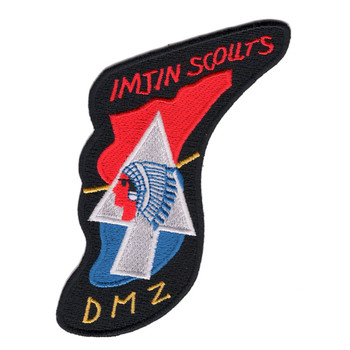
The red and blue shape behind the arrowhead on this patch is the Korean peninsula, the North stitched in red and the South in blue, with a yellow bar laid across where the two meet. Over it sits a white arrowhead carrying an Indian head in a feathered war bonnet, the Indianhead the 2nd Infantry Division is known by. The men who wore this earned it north of the Imjin River, on the American sector of the Demilitarized Zone, between 1965 and 1991. A 1967 division regulation, 2nd Infantry Division Regulation 672-3, tied it to commendable service on 20 operational missions along the zone. Ten-man teams rotated into the DMZ for three months at a time and patrolled it year round.
The program ran until October 1991, when responsibility for that stretch of the zone passed to the Republic of Korea Army. About nine of every ten Imjin Scouts were American soldiers, and the rest were KATUSA soldiers, Koreans serving inside U.S. units. The late 1960s were the hardest years on the line. In January 1968, 31 North Korean commandos came across to try for President Park Chung-hee at the Blue House in Seoul, and only one of them, Kim Shin-jo, was taken alive. In August 1976 the axe murder incident at Panmunjom brought Operation Paul Bunyan, and the whole division went to a war footing again.
The patch is cut to the outline of the design, so the edge follows its curves instead of a circle or a box, and a tan border runs all the way around. IMJIN SCOUTS is stitched in red across the top of a black field, and DMZ sits in red at the bottom. The map fills the middle, red over blue, with the yellow bar crossing behind the arrowhead. The Indianhead is worked in red, blue and gray, the feathers of the bonnet laid in one by one. It measures 2.5 inches wide by 4.25 inches tall, with a cut edge and iron-on backing.
For most of the Cold War the DMZ was one of the few places American infantry faced an enemy army across a fence every single night. The work was ambushes, patrols and long hours in observation posts, done in a war that had stopped on paper in 1953 and never quite stopped on the ground. Twenty missions was the standard, and plenty of men went far past it; retired Sgt. Mark Heathco logged 385 patrols and wrote about them in Call Sign Purple Three. Inside the 2nd Infantry Division the title carried weight because everybody knew what it took. Men who have it still recognize each other by it.
It belongs on a vest beside an Indianhead patch, or in a shadow box with the photos from the zone and the Korea Defense Service Medal. It is also a fitting gift for a father or an uncle who walked the DMZ and only talks about it with the men who were there. One patch, earned the slow way, and known on sight by anyone who served on the line.
Related Products