AOE-4 USS Detroit Fast Combat Support Ship Patch
- SKU:
- 248
- MPN:
- 248
- Width:
- 3.00 (in)
- Height:
- 4.00 (in)
- Depth:
- 0.08 (in)
- Backing:
- Sew On
- Edging:
- Merrowed Edge


Description
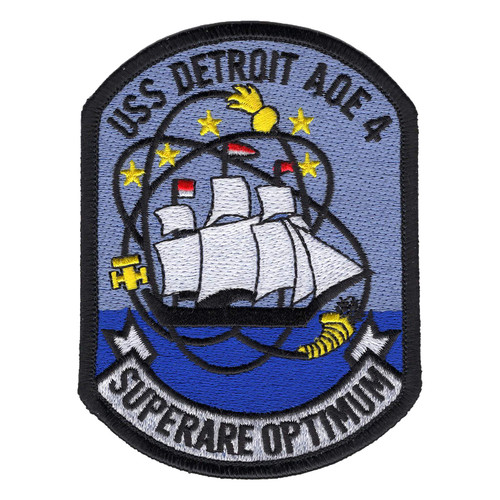
The five gold stars over the sailing ship on this patch stand for the five Navy ships named Detroit, and the ship itself is the first one, a British vessel captured at the Battle of Lake Erie in 1813. Everything else on the design is about the job. The flaming mine is ammunition, the valve is fuel, and the cornucopia is food and stores, the three things a fast combat support ship carried to the fleet. The orbit lines around the ship mark the nuclear age she was built for. USS Detroit AOE-4 was the fourth and last of the Sacramento-class fast combat support ships, and her motto, Superare Optimum, means to surpass the finest.
Puget Sound Naval Shipyard in Bremerton laid her down on 29 November 1966, launched her on 21 June 1969 and commissioned her on 28 March 1970. She was homeported at Newport, Rhode Island, then Norfolk from 1974, and Naval Weapons Station Earle in New Jersey from 1990. Detroit escorted USS Saratoga CV-60 to the southern tip of Africa in 1972, sailed with the USS Forrestal CV-59 task group in 1978, and was in the Gulf of Sidra exercises in 1981 when Libyan aircraft were shot down. She supported the Multi-National Peacekeeping Force off Beirut in 1983 and 1984. When Desert Storm began on 17 January 1991 she was one of two fast combat support ships on station in the Red Sea, and she later deployed with the USS Theodore Roosevelt CVN-71 and USS Enterprise CVN-65 battle groups.
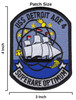
The patch is 3 inches wide and 4 inches tall, an upright tab with a rounded top and a black merrowed edge. USS DETROIT AOE 4 arcs across the top in black over a gray-blue sky. A white full-rigged ship with red and white pennants sails across the center, ringed by black orbit lines, with the five gold stars arching overhead. The flaming mine sits at top center, the gold valve wheel on the left and the striped cornucopia low on the right, just above a royal blue sea. A gray banner with a white star at each end carries SUPERARE OPTIMUM across the bottom.
An AOE crew worked the hardest kind of seamanship there is, running alongside a carrier or a destroyer at speed with fuel hoses and highlines rigged, often at night and in any sea. The deck force, boatswain's mates, gunner's mates and supply sailors aboard Detroit kept battle groups at sea for months without a port call. She did that for thirty-five years, from the Cold War Mediterranean through Desert Storm and Operation Desert Fox in 1998. She was decommissioned on 17 February 2005. For the sailors who rigged her stations, the motto on that banner was a working standard.
The backing is sew-on, so put a few stitches around the merrowed edge to fix it to a jacket, vest or sea bag rather than using an iron. It fits a shadow box next to a Detroit cruise book and a Desert Storm ribbon, or a vest worn to a ship's reunion. It is also a good gift for a shipmate who rode her or a family member of one. One-stop shopping for the fleet, on one patch.
Related Products