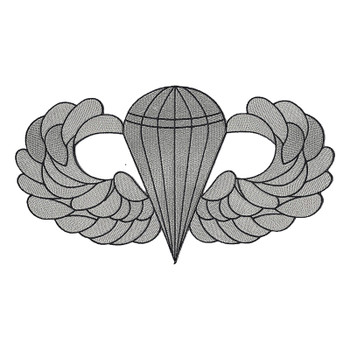
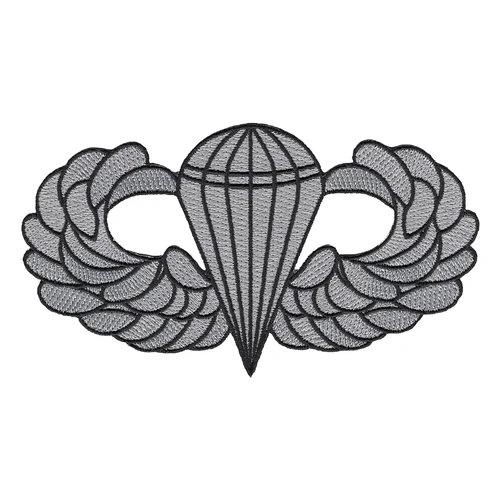
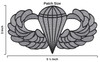
Airborne Basic Jump Wings Badge 5 inch Patch
- SKU:
- 876
- MPN:
- 876
- Width:
- 5.50 (in)
- Height:
- 3.00 (in)
- Depth:
- 0.08 (in)
- Backing:
- Sew On
- Edging:
- Cut Edge


Description
Captain William P. Yarborough designed the parachutist badge in 1941, and the War Department approved it that March. The Army's first paratroopers were still being trained when the wings were drawn. More than eighty years later the basic badge looks almost the same. Five jumps out of an aircraft in flight is still the price. Every paratrooper remembers the day the wings went on his chest.
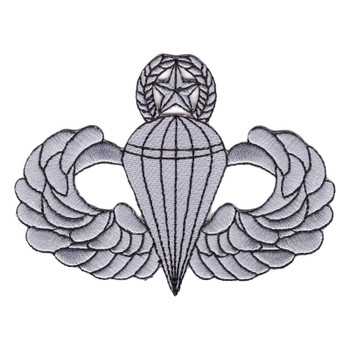
The basic badge comes from the Basic Airborne Course at the Airborne School at Fort Benning, Georgia. The course runs in three phases, ground week, tower week and jump week, and jump week means five qualifying jumps in different configurations. Soldiers, Marines, sailors and airmen all go through the same course for the same wings. Senior wings add a star over the canopy and take 30 jumps, 15 with combat equipment, plus jumpmaster qualification. Master wings put a wreath around that star and take 65 jumps. A paratrooper who jumps into combat adds bronze stars to the badge, and five or more combat jumps earn a single gold star on the shroud lines.
This is a large version, 5.5 inches across and 3 inches tall, cut to the outline of the wings with no background. The canopy, gore lines and shroud lines are stitched in silver gray, with every feather on the two upswept wings picked out in black. There is no star and no wreath, so these are basic wings, the set every jumper starts with. Big enough to read across a room, on a jacket back or a range bag. The sew-on backing is made to be stitched down to stay.
Yarborough also came up with the background trimming, the colored ovals behind the wings that tell you which airborne unit a paratrooper belongs to. That small piece of cloth is how an airborne soldier spots one of his own. The basic wings are the one thing every paratrooper shares, from the World War II jumpers of 1944 to the class graduating this year. Black hat instructors, the 34-foot tower and the first door are common ground for all of them. Wear these and anyone who went through Benning knows what they mean.
Stitch it to the back of a vest or a jacket for an airborne reunion, or frame it in a shadow box with a jump log and a class photo. It also makes a good gift for a son or daughter heading to the Airborne School, or for a grandfather who made his jumps decades ago. Sew it down once and it stays put. Five jumps, one set of wings.
Related Products