
Army Airborne Master Parachutist Jump Wings Patch
- SKU:
- 12058
- MPN:
- 12058
- Width:
- 4.00 (in)
- Height:
- 3.00 (in)
- Depth:
- 0.08 (in)
- Backing:
- Sew On
- Edging:
- Cut Edge


Description
Sixty-five jumps is only the first line of what the wreath around that star asks for. The Master Parachutist Badge sits at the top of the Army's three parachutist badges. The basic wings have a plain canopy, the senior badge adds a star above it, and the master badge circles that star with a wreath. Every paratrooper in a formation can read the difference from across the drop zone. It is the badge of the jumpmaster, the soldier who has run the door and put a stick out over the green light.
Captain William P. Yarborough designed the first Army parachutist badge in 1941, and the War Department approved it that March. Yarborough also drew the senior and master badges, which were authorized in 1949, and the star devices for combat jumps. To wear the master badge a paratrooper needs at least 65 jumps, 25 of them static-line jumps with combat equipment and an individual weapon. He needs four night jumps, one as jumpmaster of a stick, and five mass tactical jumps ending in an airborne assault problem with a battalion-size unit or larger. Add a jumpmaster course or 33 noncombat jumps as jumpmaster, and 36 months on jump status.
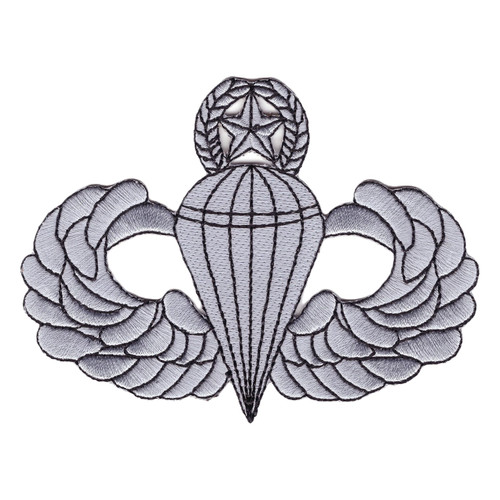
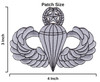
This patch is 4 inches wide and 3 inches tall, cut to the outline of the badge so no fabric shows past the feathers. The whole design is stitched in silver-gray thread with fine black outlining on every feather, every canopy gore and every shroud line. The shroud lines run down to a single point below the canopy, and the curled wings sweep out on both sides. At the top, one star sits inside its laurel wreath. There are no combat stars on the shroud lines, so it is the master badge as most jumpmasters wore it. It has a sew-on backing.
Plenty of soldiers have pinned on basic wings at Fort Benning. Far fewer stayed on jump status long enough, and went out the door often enough, to wear the star and wreath. Master wings are years of airborne units, night drops, rigging and safety checks, and the trust of every jumper who stood up and hooked up behind him. Jumpmasters are the reason a stick lands together. Anyone who has worn these wings knows exactly what it took.
Sew it on a ruck, a jacket or the vest you wear to an airborne reunion, or frame it in a shadow box beside a jump log and a set of blousing bands. It also makes a fine gift for a paratrooper who wore the star and wreath. Silver wings, one star and a wreath.
Related Products


