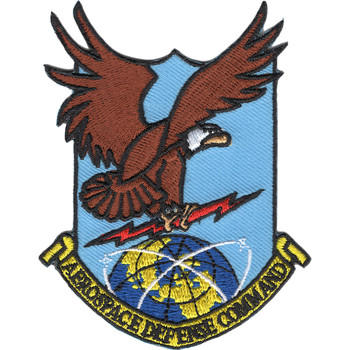
Air Defense Command Patch

- SKU:
- 398
- MPN:
- 398
- Width:
- 2.75 (in)
- Height:
- 3.50 (in)
- Depth:
- 0.08 (in)
- Backing:
- Iron On
- Edging:
- Cut Edge
- Era:
- Cold War


Description
Air Defense Command was established on 21 March 1946 and activated at Mitchel Field, New York, six days later, and for most of the next 34 years its job was to stop any bomber headed for North America. It was folded under Continental Air Command in 1948 and discontinued in 1950. On 1 January 1951 it came back as a major command, and a week later its headquarters moved to Ent Air Force Base, Colorado. On 15 January 1968 it was renamed Aerospace Defense Command. The command was inactivated on 31 March 1980, with its resources divided between Tactical Air Command and Strategic Air Command.
ADC flew a long line of interceptors. North American's F-86D Sabre interceptor came first in numbers, with more than 1,000 in service by the end of 1955, alongside the F-89 Scorpion and the F-94 Starfire. The F-102A Delta Dagger, the Deuce, arrived in 1956, and the F-101B Voodoo followed in 1959. The F-106 Delta Dart, the Six, went first to the 539th Fighter Interceptor Squadron at McGuire AFB, New Jersey, in May 1959 and was the primary interceptor of the 1970s. Ground controllers ran intercepts through SAGE, the Semi-Automatic Ground Environment, with radar from the Pinetree Line in Canada, DEW Line stations in the Arctic and the Texas Towers off New England. After the NORAD agreement was signed on 12 May 1958, ADC became a NORAD component.
The patch is 2.75 inches wide and 3.5 inches tall, a shield cut to the outline of the design with a black border. A brown eagle with a white head dives down the blue field, its wings sweeping up past the top of the shield. Its talons grip a red lightning bolt over a blue globe, and two white jets fly crossing arcs around that globe. A gold scroll across the bottom reads "AIR DEFENSE COMMAND" in black letters. Eagle, lightning and orbiting jets make a plain picture of the mission: watch the whole sky and hit fast.
ADC duty meant alert. Interceptor crews sat in alert hangars ready to scramble when an unknown track came up on the scopes. Radar operators worked long nights at remote sites on mountaintops and coastlines, and the men on the Texas Towers lived on steel platforms out in the Atlantic. Maintainers kept the Deuces, Sixes and Voodoos ready at every hour of the day. Done right, nobody outside the command ever heard about it, which was exactly the point.
It fits a shadow box with fighter interceptor squadron patches and a photo of the old alert hangar, or a jacket worn to a squadron reunion. It is also a good gift for a father or grandfather who flew, fixed or controlled interceptors during the Cold War. Measures 2.75 x 3.5 inches with a cut edge and iron-on backing, and it can also be sewn on.
Related Products