
Aerospace Defense Command Patch
- SKU:
- 13317
- MPN:
- 13317
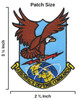
- Width:
- 2.75 (in)
- Height:
- 3.50 (in)
- Depth:
- 0.08 (in)
- Backing:
- Iron On
- Edging:
- Cut Edge
- Era:
- Cold War


Description
On 15 January 1968 the Air Force changed one word in a command's name, and Air Defense Command became Aerospace Defense Command. The new name followed the mission. By then the command was tracking satellites and watching for ballistic missiles as well as hunting bombers. ADCOM ran its fighters, radars and space sensors from Ent Air Force Base and the Chidlaw Building in Colorado Springs. It was the American half of NORAD, and for twelve years its people stood the watch over the continent.
The interceptor force, built under Air Defense Command before its 1968 renaming, flew the Century Series. F-102A Delta Daggers arrived in 1956, and the F-101B Voodoo and F-106 Delta Dart followed in 1959. Through the 1970s the F-106, the Six, was the primary interceptor on the alert pads, while the Voodoos and Deuces moved to the Air National Guard. Behind the jets stood the SAGE radar network, the DEW Line across the Arctic and, for a time, the CIM-10 Bomarc missile. In 1975 ADCOM became a specified command, with one commander serving as both CINCNORAD and CINCAD.
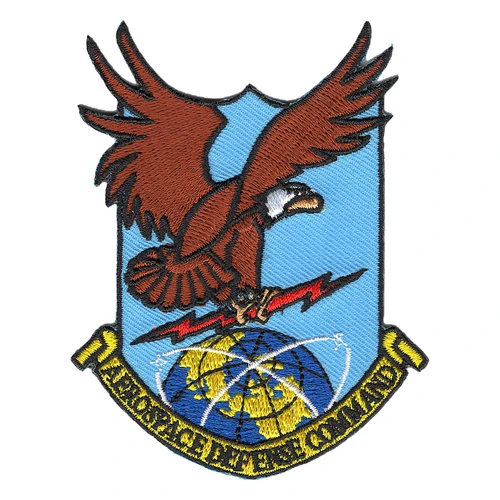
The patch is shield-shaped, 2.75 inches wide and 3.5 inches tall, with a cut edge that follows the eagle's spread wings past the top of the shield. A brown eagle with a white head dives across a light blue field, a red lightning bolt clamped in its talons. Under it sits a blue globe with yellow continents and a black grid. Two white orbit lines circle that globe, fitting for a command that took on space surveillance in 1960 and 1961. A yellow scroll along the bottom spells out AEROSPACE DEFENSE COMMAND in black letters.
Air defense was a job measured in minutes. Crews lived beside their jets in alert barns, and radar controllers watched scopes through every shift so the fighters could launch the moment a track came up unknown. Most of that work never made the papers, because the goal was for nothing to happen. On 1 October 1979 the fighters, radars and bases moved to Tactical Air Command as ADTAC, and on 1 December 1979 missile warning and space surveillance went to Strategic Air Command. The major command was inactivated on 31 March 1980.
Press it onto a flight jacket with the iron-on backing, or stitch around the edge for a patch that will see heavy wear. It fits a shadow box beside F-106 or fighter interceptor squadron patches, or a vest worn to an air defense reunion. It is also a good gift for a father or grandfather who pulled alert during the Cold War. The scopes were watched every night, and this is the command that watched them.
Related Products


