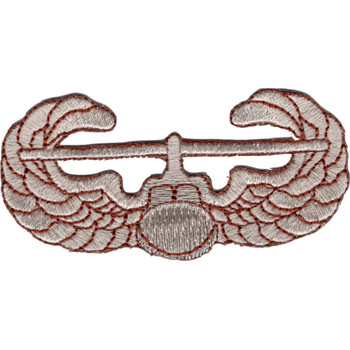
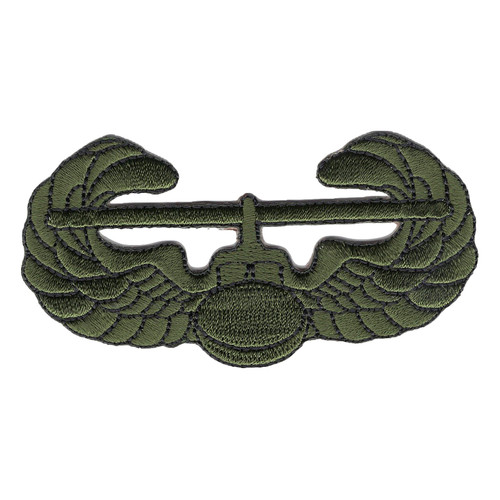
Air Assault Wings Badge Patch Subdued
- SKU:
- 2720
- MPN:
- 2720
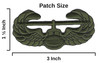
- Width:
- 3.00 (in)
- Height:
- 1.50 (in)
- Depth:
- 0.08 (in)
- Backing:
- Iron On
- Edging:
- Cut Edge


Description
The shape in the middle of the Air Assault Badge is the nose of a UH-1 Huey seen head on, and the bar across the top is its rotor blade standing in for a wing. Maj. Jack R. Rickman of the 101st Airborne Division is credited with the design, drawn in Vietnam in 1971. It borrows the curve of the Parachutist Badge and the idea of the World War II Glider Badge, with the helicopter taking the glider's place. The 101st authorized it as the Airmobile Badge effective April 1, 1974. When the division became the 101st Airborne Division (Air Assault) on October 4, 1974, the badge took the new name too.
Maj. Gen. Sidney B. Berry, commanding the 101st, signed the division order that created the badge in February 1974. The Army Chief of Staff approved it for Army-wide wear on January 18, 1978. The Air Assault School at Fort Campbell, Kentucky, has run since 1974, and other posts have run their own courses or hosted mobile training teams over the years. The course runs about ten and a half days: Day Zero with its obstacle course and two-mile run, then Combat Assault, Slingload Operations and Rappelling phases. Students rappel from a 34-foot tower and from a UH-60 Black Hawk hovering at 70 to 90 feet, and finish with a 12-mile foot march in under three hours.
This is the subdued version, olive drab green with black outline stitching, cut to the silhouette of the badge. It measures 3 inches wide by 1.5 inches high. The wings sweep up and curl in at the tips, the rotor bar runs straight across the top, and the Huey nose sits low and centered, rounding out into the oval at the base. Every feather of the wings is picked out in black thread. The backing is iron-on, and it can be sewn on for a longer hold.
Every soldier wearing these wings got them by surviving the same test: slingloads rigged right on the first try, rappels off the tower and the Black Hawk, and a rucksack carried 12 miles against the clock. The 101st built its identity around air assault, and the division still carries the words in its name. Anyone who knows the course knows what a soldier went through to wear the badge. Graduates tend to remember the instructors and the obstacle course longer than anything else.
Sew it to a range bag or a plate carrier cover, or mount it in a shadow box beside your Screaming Eagle patch and your course certificate. It also makes a good gift for a soldier heading to Fort Campbell, or a veteran who earned the badge decades ago. A Huey nose, a rotor blade and two wings.
Related Products