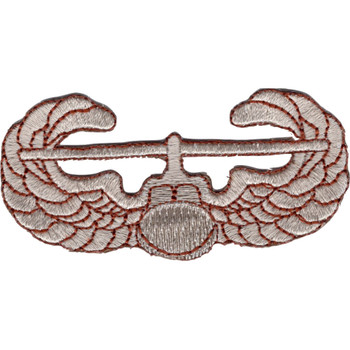
Air Assault Wings Badge Patch

- SKU:
- 2718
- MPN:
- 2718
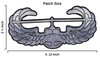
- Width:
- 5.12 (in)
- Height:
- 2.50 (in)
- Depth:
- 0.08 (in)
- Backing:
- Iron On
- Edging:
- Cut Edge


Description
Maj. Jack R. Rickman drew the Air Assault Badge in 1971 while serving with the 101st Airborne Division in Vietnam, and he never earned the badge himself. The design borrows from the Parachutist Badge and the World War II Glider Badge. A helicopter faces you nose-on, its rotor blade laid across the top, with wings curling up and over at both ends. The 101st adopted it for local wear as the Airmobile Badge on 1 April 1974. It became the Air Assault Badge when the division took the Air Assault designation that October, and the Army Chief of Staff approved it for Army-wide wear on 18 January 1978.
The idea goes back further than the 101st. Troops of the 11th Air Assault Division (Test) wore an earlier air assault badge, first awarded in 1964, while the Army worked out how to fight from helicopters. That test division's people and doctrine became the 1st Cavalry Division (Airmobile), which flew UH-1 Iroquois Hueys into the Ia Drang Valley in November 1965. The 101st fought as an airmobile division in Vietnam and brought the mission home to Fort Campbell, Kentucky. The Army Air Assault School, run by the 101st Airborne Division (Air Assault) at Fort Campbell since 1974, now trains soldiers to rig sling loads for UH-60 Black Hawks and CH-47 Chinooks and to rappel from a hovering aircraft.
This patch is cut to the outline of the wings, 5.12 inches across and 2.5 inches tall. The feathers are stacked in rows of gray thread, darker at the base and silver at the curled tips. The helicopter sits in the center with its two windows stitched in black, and the rotor bar runs in bright silver from wingtip to wingtip. A thin black outline holds every edge so the shape stays crisp against a uniform jacket or a dark vest. Anyone who earned the wings will know the silhouette from across the room.
The course runs ten and a half days, and a lot of students never make it past Day Zero, the obstacle course and two-mile run that decide who becomes an Air Assault student. Then come the Combat Assault, Sling Load and Rappelling phases, each with written and hands-on tests. The sling load phase ends with a hands-on test in which students inspect rigged loads for deficiencies. Graduation day starts with a 12-mile foot march in full gear with a rucksack, finished in under three hours. Soldiers from every kind of unit go through it, and the wings mean the same thing on all of them.
Frame it in a shadow box with your Air Assault certificate and a photo from the rappel tower, or put it on the jacket you wear to 101st reunions. It also makes a good gift for a new graduate or for a father who earned his wings at Fort Campbell. The patch has an iron-on backing and can be sewn on for a permanent hold. Small enough for a jacket, big enough to be seen across a room.
Related Products