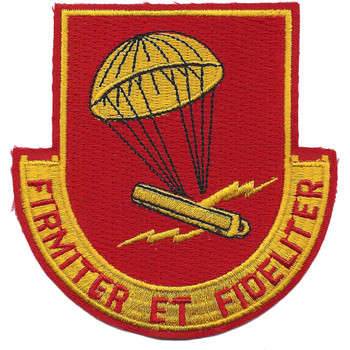
WWII Airborne Paraglider Enlisted Patch

- SKU:
- 9272
- MPN:
- 9272
- Width:
- 2.00 (in)
- Height:
- 2.00 (in)
- Depth:
- 0.08 (in)
- Backing:
- Iron On
- Edging:
- Cut Edge

Description
The glider on this patch points to the viewer's left, and that one detail is what made it the enlisted version of the World War II airborne paraglider device. On the officers' version the glider faced the other way. The small blue disc with the red border was worn on the side of the garrison headgear by airborne soldiers in divisions such as the 82nd and the 101st. It put a parachute and a glider on one emblem because those were the two ways an airborne soldier went into battle. A man wearing it could have come down under a canopy or ridden in on a towed glider.
The 82nd was converted to an airborne division in August 1942, and the 101st Airborne was activated that same month. Both divisions fielded glider infantry next to their parachute regiments, the 325th Glider Infantry Regiment in the 82nd and the 327th Glider Infantry in the 101st. The glider men flew into combat in the Waco CG-4A, an engineless troop glider towed behind a C-47 and cut loose over the landing zone. In Normandy the 325th came in by glider on June 7, 1944, the day after the parachute assault, in the landings called Mission Hackensack. Gliders carried troops, jeeps and artillery into Holland again in September 1944 for Operation Market Garden.
The patch is a 2 inch round disc with a red embroidered border and a cut edge around a royal blue field. A white parachute canopy fills the top half, its shroud lines drawing down to a point near the bottom of the disc. Across the lines lies a white glider on a diagonal, high wing spread wide, nose toward the lower left and tail fin up to the right. It is the same small round device that shows up in so many wartime portraits of airborne soldiers.
A glider had no engine and no second pass. Once the tow line dropped, the pilot had one approach into whatever field he could reach, and the infantry inside climbed out ready to fight with whatever had landed in one piece. Glider landings in Normandy and Holland cost the glider pilots and glider infantry dearly. The paratroopers got the attention, but the airborne divisions depended on the men and heavy equipment that came in by glider. This disc put both of them under the same emblem.
Set it in a shadow box beside a father's or grandfather's jump wings, his Glider Badge and his division shoulder patch. It also fits on the jacket or vest worn to an airborne reunion. The iron-on backing holds it in place, and a few stitches make it permanent. A small patch, and it still says how he got there.
Related Products