VF-103 Patch Fighting 103 Jolly Rogers-FLAG
- SKU:
- 1335
- MPN:
- 1335
- Width:
- 4.25 (in)
- Height:
- 5.00 (in)
- Depth:
- 0.08 (in)
- Backing:
- Iron On
- Edging:
- Merrowed Edge
- Squadron Type:
- Fighter and Strike Fighter Squadrons (VF / VFA / VA)



Description
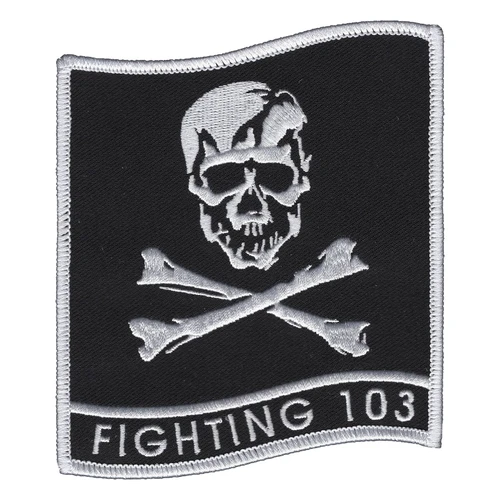
VF-103 started out as the Sluggers and only took the skull and crossbones in 1995, after VF-84 was disestablished on 1 October of that year. Three Navy fighter squadrons have flown the Jolly Roger, VF-17 in World War II, VF-84 and then VF-103, and none of them descends from the others. The name and the flag passed from one ready room to the next anyway. This patch is cut as that flag, a black jolly roger snapping in the wind. FIGHTING 103 across the bottom is the old way of saying Fighter Squadron 103. The squadron kept that VF designation until February 2005.
VF-103 was activated on 1 May 1952 and flew the FG-1D Corsair and the F9F Cougar before moving to the F8U Crusader in 1957. The F-4 Phantom II came in 1964, and in 1972, during Linebacker, a VF-103 crew shot down a MiG-21 with an AIM-7 Sparrow, credited as the first night MiG kill with the Sparrow. The squadron flew the F-14 Tomcat from 1983 to 2004, most of those years from USS Saratoga CV-60. In October 1985, VF-103 and VF-74 Tomcats intercepted the Egyptian airliner carrying the Achille Lauro hijackers and forced it down at NAS Sigonella, Sicily. After Saratoga the squadron deployed on USS Enterprise CVN-65, USS Dwight D. Eisenhower CVN-69, USS George Washington CVN-73 and USS John F. Kennedy CV-67. It moved to the F/A-18F Super Hornet in 2004 and became VFA-103 in February 2005.
The patch measures 4.25 inches wide by 5 inches tall, with the top and bottom edges rippling like cloth in the wind. The skull is stitched large in white and gray shading over a solid black field, with the crossed bones laid under it at a slant. A curved white line sweeps across the lower third, and below it FIGHTING 103 runs in white block capitals. A white merrowed edge rolls around the entire outline. The back is iron-on.
On the fourth day of Desert Storm in January 1991, a VF-103 F-14A+ flying an escort mission was brought down, probably by an SA-2. The RIO, Lt. Larry Slade, was captured and held as a prisoner of war, and the pilot, Lt. Devon Jones, evaded and was picked up by Air Force Special Operations Forces. The squadron spent nearly three decades on Saratoga and flew the Phantom and then the Tomcat for about twenty years each. Today the Jolly Rogers fly Super Hornets from NAS Oceana, Virginia, with Carrier Air Wing Seven. The skull and crossbones still rides on the squadron's jets today.
Mount it in a shadow box beside a Saratoga cruise book and a set of wings, or sew it on the flight jacket worn to a squadron reunion. It is also a good gift for a son or grandson whose father turned wrenches or flew in the Jolly Rogers. Press it on with the iron-on backing, or stitch it down for the long haul. One flag, one squadron, Fighting 103.
Related Products