
VC-63 Composite Squadron Patch
- SKU:
- 12076
- MPN:
- 12076
- Width:
- 4.50 (in)
- Height:
- 4.50 (in)
- Depth:
- 0.08 (in)
- Backing:
- Sew On
- Edging:
- Merrowed Edge
- Squadron Type:
- Fleet Logistics and Support Squadrons (VR / VRC / VRF / VAW / VW)
- Era:
- World War II


Description
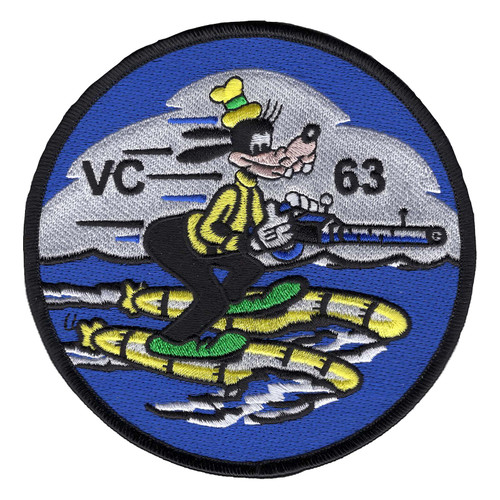
A composite squadron flew fighters and torpedo planes off the same small deck, and this VC-63 patch carries both jobs: two torpedoes underfoot and a gun in hand. VC-63 was commissioned on May 20, 1943, at NAS Alameda, California, under Lt. Cdr. Seth S. Searcy Jr. It was built for the escort carriers, the jeep carriers that covered landings, convoys and anti-submarine patrols across the Pacific. The squadron did that work through the Marshalls and the Bismarcks in 1944. The cartoon riding those torpedoes is the squadron's grin on a hard job.
VC-63 started out with F4F-4 Wildcat fighters and TBM-1 Avengers, picked up FM-1s in September 1943, and took fifteen FM-2 Wildcats and four TBF-1C Avengers aboard on March 15, 1944. After a qualification cruise on USS Copahee CVE-12 in November 1943, the squadron went aboard USS Natoma Bay CVE-62 and made about 1,800 landings on her deck. It covered the landings at Majuro on January 30, 1944, struck Maloelap on February 1 and Wotje on February 18, and spotted naval gunfire at Taroa. It escorted a convoy from Guadalcanal to Emirau, covered the bombardment of Kavieng and hit Tadji airdrome and Aitape on New Guinea in April 1944. Anti-submarine and combat air patrols filled the days in between.
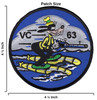
The patch is round, a royal blue field inside a black merrowed edge, with VC and 63 in black over a gray cloud. A cartoon dog in a yellow sweater and a green and yellow topper rides two yellow torpedoes like water skis, kicking up white wake, while he fires a gun forward with speed lines streaming behind him. The torpedoes can be read as the Avenger crews and the gun as the Wildcat pilots, one squadron and two missions. It measures 4.5 inches across with a sew-on backing. It is a bright, cheerful piece of WWII squadron art.
Escort carrier squadrons lived on short decks, short catapult strokes and long hours of patrol over empty ocean. Lt. Joseph A. Styles, the first executive officer, was killed in a crash on June 23, 1943, weeks after commissioning, and Lt. William C. Rivers took his place. The squadron left Natoma Bay at Pearl Harbor in May 1944 and came ashore at San Diego on July 16, 1944. That August its people reported to NAS San Diego to await orders to NAS Alameda, where the squadron was to be reformed. Cartoon squadron art like this was everywhere in the jeep carrier Navy, and it kept a sense of humor alive in hard work.
Frame it in a shadow box with a photo of a father or grandfather who flew or maintained aircraft with VC-63, or with a Natoma Bay patch beside it. It also suits a jacket for a WWII history event or a gift for a family member researching a squadron veteran. The sew-on backing holds well on a flight jacket or a display board. It is a patch for a squadron that did steady, unglamorous work far out in the Pacific.
Related Products


