USS Nassau LHA-4 Amphibious Assault Ship Patch

- SKU:
- 9787
- MPN:
- 9787
- Width:
- 4.00 (in)
- Height:
- 4.00 (in)
- Depth:
- 0.08 (in)
- Backing:
- Iron On
- Edging:
- Merrowed Edge



Description
In the final week of Desert Storm, USS Nassau LHA-4 worked as a Harrier carrier, with Marine AV-8B Harrier IIs operating off her flight deck. She had done the job a decade earlier. In 1981 she spent about ten weeks in the Mediterranean as a de facto aircraft carrier supporting USS Saratoga. Nassau was a Tarawa-class amphibious assault ship built by Ingalls Shipbuilding in Pascagoula, Mississippi. She was commissioned there on 28 July 1979 and decommissioned at Norfolk, Virginia, on 31 March 2011.
Her keel was laid on 13 August 1973 and she was launched on 21 January 1978, carrying the name of the escort carrier USS Nassau CVE-16. Soon after commissioning she deployed to reinforce the base at Guantanamo Bay and earned the Navy Meritorious Unit Commendation. In February 1984 she went to Beirut with the 24th Marine Amphibious Unit. The 1990s brought Desert Shield and Desert Storm, then Operations Uphold Democracy, Deny Flight, and Allied Force and Noble Anvil over Kosovo. Late in her career she anchored off Galveston after Hurricane Ike in 2008 and was diverted to Haiti for earthquake relief in January 2010.
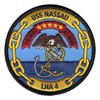
This patch is a 4-inch circle with a black merrowed edge and an iron-on backing. A ring of gold stud-link anchor chain runs around it, broken by a gold band at the top reading USS NASSAU and another at the bottom reading LHA 4. Inside, a red scroll set with five gold stars reads PRIMA on one side and AD MARE on the other. In English the ship's motto was First from the Sea. Beneath it a bald eagle spreads brown wings and grips a silver anchor wound with gold line. The sky is light blue over a dark blue sea, fitting for a ship that worked where the two meet.
An LHA is two services on one hull. Sailors run the ship, the well deck and the flight deck, and the embarked Marines bring the helicopters, the Harriers and the troops who go ashore. Nassau did that for nearly 32 years, from Guantanamo to Beirut and the Persian Gulf. When the job was relief instead of combat, the same deck and well deck carried help ashore at Galveston and in Haiti. Sailors and Marines who rode her remember a ship that was always somewhere.
Hang it in a shadow box beside a cruise book and a Marine unit patch, or put it on a jacket or vest for a ship's reunion. It makes a good gift for a shipmate who rode Nassau, a Marine who flew or fought from her deck, or a family member who wants to know where their sailor spent those deployments. The iron-on backing goes on cotton or canvas with a household iron, and a few stitches around the merrowed edge will keep it on hard-used gear. First from the Sea, four inches across.
Related Products